Followers

Powered by Blogger.
RSS
One highly opinionated feminist YA nerd's twisted, snarky and informative journey through the genre's perils, pitfalls and sparkles.

Review: "Bad Hair Day" by Carrie Harris.

“Bad Hair Day”

Author: Carrie Harris

Publisher: Delacorte Press

Pages: 240

Summary (taken from GoodReads): Senior year is positively hair-raising.

Kate Grable is geeked out to shadow the county medical examiner as part of her school’s pre-med program. Except when he’s arrested for murder, she’s left with the bodies. And when Kate’s brother Jonah stumbles upon a dead gamer girl, she realizes that the zombie epidemic she cured last fall was only the beginning of the weirdness taking over her town. Someone’s murdering kids—something really hairy. And strong. Possibly with claws.

Is it werewolf awesomeness like Jonah and his dorktastic friends think? Kate’s supposed to be a butt-kicking zombie killing genius...but if she can’t figure out who’s behind the freakish attacks, the victims—or what’s left of them—are going to keep piling up.

It’s scary. It’s twisted. It’s sick. It’s high school.

Cover impressions: I had the first book in the series, “Bad Taste in Boys” on my radar thanks to its gleefully kitsch 50s sci-fi B-movie synopsis yet never got around to reading it, mainly because I could never find it in UK and I’m too cheap to pay for shipping. I began reading the 2nd in the series with the typical hesitations of a reader coming into a series without the full story, but luckily it was easy enough to pick up in this short, if tiresome read. Once again, this is a paranormal YA that promises big and doesn’t deliver.

I really should have written this review straight after finishing the book, but university work got in the way, because it was entirely forgettable and I’m having trouble remembering simple elements such as character names. This isn’t a good sign. Unfortunately, “Bad Hair Day” is generic in every sense of the word. The heroine is the geek who doesn’t know she’s pretty, the handsome but bland love interest, the shoe-horned in romantic conflict, the quirky but mostly absent parents and sibling, the casual disparaging comments towards girls who present a threat – they’re all here. At times it feels like join-the-dots storytelling, especially since the pacing for this short book is completely erratic, veering between fumbled exposition and drawn out and entirely unnecessary romance subplot and shorts bursts of action that do nothing to liven up what should be a short, silly read. Despite the attempts at humour – and I did snigger once or twice – the book never fully decides whether it wants to be a camp take on kitschy horror and sci-fi or a conventional paranormal tale. I’m personally quite disappointed that it didn’t take the latter route since the genre desperately needs less po-faced seriousness.

The book reads younger than YA, with the immaturity of the supposed genius teenage heroine seeming more suited to a middle-grade character. There is potential present in the spin on the zombie and werewolf mythos, grounding it in science rather than legend, but it falls flat due to painful exposition and a lack of focus. There’s nothing in this book to outright hate, it’s just too bland and inoffensive for that.

2/5.

My ARC was received from NetGalley.com. "Bad Hair Day" will be released in USA on 13th November 2012.

  • Digg
  • Del.icio.us
  • StumbleUpon
  • Reddit
  • RSS

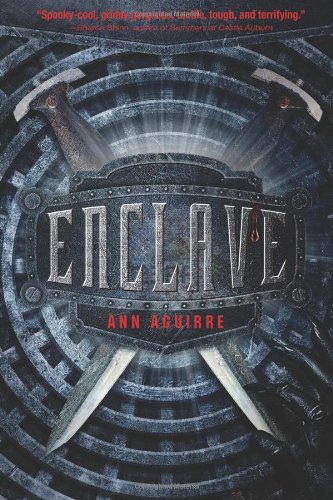
Review: "Enclave" by Ann Aguirre


"Enclave"

Author: Ann Aguirre

Publisher: Feiwel and Friends

Pages: 259

Summary (taken from GoodReads): In Deuce’s world, people earn the right to a name only if they survive their first fifteen years. By that point, each unnamed ‘brat’ has trained into one of three groups–Breeders, Builders, or Hunters, identifiable by the number of scars they bear on their arms. Deuce has wanted to be a Huntress for as long as she can remember.

As a Huntress, her purpose is clear—to brave the dangerous tunnels outside the enclave and bring back meat to feed the group while evading ferocious monsters known as Freaks. She’s worked toward this goal her whole life, and nothing’s going to stop her, not even a beautiful, brooding Hunter named Fade. When the mysterious boy becomes her partner, Deuce’s troubles are just beginning.

Down below, deviation from the rules is punished swiftly and harshly, and Fade doesn’t like following orders. At first Deuce thinks he’s crazy, but as death stalks their sanctuary, and it becomes clear the elders don’t always know best, Deuce wonders if Fade might be telling the truth. Her partner confuses her; she’s never known a boy like him before, as prone to touching her gently as using his knives with feral grace.

As Deuce’s perception shifts, so does the balance in the constant battle for survival. The mindless Freaks, once considered a threat only due to their sheer numbers, show signs of cunning and strategy… but the elders refuse to heed any warnings. Despite imminent disaster, the enclave puts their faith in strictures and sacrifice instead. No matter how she tries, Deuce cannot stem the dark tide that carries her far from the only world she’s ever known.

Cover impressions: After receiving a copy of this book from GoodReads friend Lucy, I was immediately drawn to the Publisher’s Weekly quote declaring the book to be “for fans of The Hunger Games”. Such comparison quotes, while attention grabbing and common practice amongst publishers, immediately set up a certain level of expectations, even in the most cynical of readers. While I haven’t actually finished reading The Hunger Games yet (I’ll get round to it eventually, I swear!), I began this book with the same expectations I have for every dystopian novel – strong world-building and a real threat & sense of danger.

There are books that make me consider discarding use of the flawed star rating system for reviews. Sometimes it’s close to impossible to summarise the qualities of a book into a simple rating out of 5, 10 or however one chooses to do so. A book can be a relatively enjoyable and competently written piece of work that would otherwise deserve a solid rating, but a certain element, event, etc, can bring its rating tumbling down. This happened to me with Sarah Beth Durst’s “Ice” and it happened with “Enclave”. But before I get to why I cannot give this book anything higher than one star, I shall discuss other elements of the book that succeed and fail.

I’m sure you’re all sick of me going on and on about this but the foundations of a strong dystopian novel lie in its world-building. Unusual or disturbing events can’t just happen for shock value. They need to be rooted in the origins of the society, grounded in reason, meaning the reason of this world. This fundamental lack of reason within the world-building in “Enclave” left more than a few questions unanswered. The underground society Deuce lives in does not name its young, known as brats, until a specific age, which is never mentioned. Why? There doesn’t seem to be any specific reasoning behind this rule and seems too impractical to fit in with a world that works to prove itself as fundamentally practical. There are hints of a cult-like mentality to the ruling class of the world but it’s barely touched upon and leaves us with half-built reasoning. Children are sanctioned into one of three groups – warriors, builders or breeders – yet the reasons for specific grouping once again seem at odds with the necessary practicality & needs of this society. One breeder, Deuce’s friend, is seen as ideal for his calling because he is handsome, but I failed to see why this would be a relevant quality in a world where death & disease are rampant. Other extremely questions go unanswered – how does this enclave have clean water after generations underground? How does Deuce go from a lifetime underground to full on exposure to sunlight and only get slightly burned with no damage to her eyesight?

The writing itself is adequate, if simple, and has well-paced action scenes, although the overall pacing is erratic. Certain scenes are evident padding and clumsy plotting, which coupled with several under-developed plot points proves to be somewhat frustrating. No character other than the heroine is given adequate time to develop beyond basic tropes, although I did warm to Deuce somewhat throughout the first half of the novel. However, it is one particular character and how others react to him that soured things for me.

A little more than midway through the novel, Deuce is kidnapped by a gang who make their intentions towards her clear – they intend to use her for breeding purposes, forcefully if need be. Later we are introduced to Tegan, a fellow kidnapped woman who has been raped repeatedly and given birth to stillborn children. After altercations with the story’s main monsters, the Freaks, the head of the gang, Stalker (yes, really), decides he will go along with Deuce, Tegan and main love interest Fade in order to have a better chance of surviving. Fade and Deuce agree to this, despite Tegan’s protests that she does not feel safe around the leader of the gang of rapists who repeatedly violated her for years. Later on, Stalker pushes Deuce against a tree and kisses her.

Deuce reciprocates.

I’ve made my thoughts clear on the ‘bad boy’ trope in YA; I don’t like it. I understand the fantasy behind being the one girl who changes the rebel but ultimately I think it’s a problematic trope that is all too often used as an excuse to have the love interest treat the heroine like dirt, often being rough with her and belittling her.

Patch from “Hush Hush” held his love interest against a bed and talked about how much he wanted to kill her after stalking her, harassing her and generally making her feel uncomfortable and unsafe.

Stalker is the leader of a gang of rapists. It is hinted at in the book that he has raped women before. It is also implied that he may have raped Deuce during her kidnapped period.

He is presented as a potential love interest to Deuce.

The aim of a good dystopian novel is to create a sense of dread. I have seen rape mentioned in other dystopian novels and within the constraints of this world where humans die young and need to reproduce quickly, it makes sense that a patriarchy dominated society would view women in such a manner. However, I have never seen rape used so casually and tossed aside so simply by a character and an author in a YA novel. There is a cruel lack of empathy for Tegan in “Enclave”. Even within the constraints of the novel’s world, one ruled by social Darwinism, to force Tegan to interact daily with the man who stood by & let her be raped repeatedly, possibly ordering the rapes himself or even engaging in the horrific act himself, is baffling at best and disgusting at worst. As the novel progresses, Tegan grows (lazily from a characterisation point-of-view) from a victim into a ‘strong’ young woman who can fight back, but all I could think about was how her rape was used in such a cavalier fashion. Deuce, who started off with such potential (even if she did fall into the typical romantic plot tropes with mysterious bad boy Fade), does not question Stalker or his past actions. Instead, she lays some of the blame on Tegan. The dismissive attitude she has towards a victim of multiple rapes is abhorrent. At one point she asks herself how Tegan could have been so weak as to allow the events to happen. Deuce’s general attitude is that life is tough, and if she can suck it up and get on with her life, so can Tegan. Even within the context of the novel, this felt wrong on every level. Deuce, who had previously shown moments of true empathy, becomes someone who sympathises more with a rapist than the victim of rape. I shouldn’t even have to explain why this made me sick. And that’s why I can’t give this book anything more than one star.

I don’t expect every book in the world to be a beacon of social justice and feminism; that would be stupid. What I do expect is for a book to follow the rules it sets for itself. “Enclave” fails on this thanks to its inconsistent and confusing choices in its world-building, which seem to exist more for shock value than any real sense of reason. It’s a mediocre novel that becomes disgusting when something as serious, life changing and horrific as rape is used so clumsily. Rape is NEVER the woman’s fault. She’s never ‘asking for it’ and she’s certainly never deserving of pity or scorn because she was unable to fight back. Bad boys are problematic enough, but making a rapist not only a sympathetic character, one who receives a degree of sympathy from the heroine not rewarded to the victim, but a potential love interest is flat-out inexcusable.

1/5.

  • Digg
  • Del.icio.us
  • StumbleUpon
  • Reddit
  • RSS

Review: "Katana" by Cole Gibsen.

“Katana”

Author: Cole Gibsen

Publisher: Flux.

Pages: 384.

Summary (taken from GoodReads): Kill Bill meets Buffy in this supernatural samurai tale.

Rileigh Martin would love to believe that adrenaline gave her the uncanny courage and strength to fend off three muggers. But it doesn’t explain her dreams of fifteenth century Japan, the incredible fighting skills she suddenly possesses, or the strange voice giving her battle tips and danger warnings. While worrying that she’s going crazy (always a reputation ruiner), Rileigh gets a visit from Kim, a handsome martial arts instructor, who tells Rileigh she’s harboring the spirit of a five-hundred-year-old samurai warrior.

Relentlessly attacked by ninjas, Rileigh has no choice but to master the katana--a deadly Japanese sword that’s also the key to her past. As the spirit grows stronger and her feelings for Kim intensify, Rileigh is torn between continuing as the girl she’s always been and embracing the warrior inside her.

Cover impressions: It’s not unusual for a book to promise more than it can deliver. One can seldom blame the book itself for that, since so much time and effort from the publishers goes into making said book as marketable as possible. The temptation of a supernatural mash-up with Asian culture was one with immeasurable potential, as well as one that could easily slip into misguided cultural appropriation. On the bright side, such awkwardness is for the most part avoided. Unfortunately, this book is also just not very good.

Immediately, my biggest complaint with the novel was its heroine, Rileigh. Not for one moment did she register as an authentic or particularly likeable teenager. Her speech rings false on every count, as do her interactions with token gay best friend Quentin, who doesn’t rise beyond the stereotype of the make-up applying squealing, hysterical gay male. I firmly believe that this can be pulled off well and used to create an interesting, complex character but in this instance it was just lazy storytelling, and such Quentin doesn’t serve much of a purpose beyond Rileigh having someone to complain about her love life with, he barely registers. The pair read more like how bad sitcom writers imagine teenagers to speak, because apparently they’re from a different planet or something. As well as the dialogue being awkward and clunky, it’s used primarily for exposition and stretched out discussions of romance, neither of which are pulled off with any particular success.

The storytelling is so awkward; it’s as if the author had fragments of an extremely conventional plot in her mind and hastily connected them together. The plotting is extremely predictable and conventional, with far too many overused YA tropes being crossed from the check-list – the flighty, irresponsible parent who is seldom there, thus allowing the heroine to continue her life without any consequences or parental guidance, the mysterious, rude and jerky designated love interest who hides secrets and stalks the heroine to make sure she’s safe, the heroine being incredibly skilled with practically no effort as well as the most super special heroine who ever lived, and so on. It is possible to take conventional tropes and subvert them in an interesting or gripping manner, and is common when referencing specific genres or modes of storytelling (the Kill Bill series and Kung Fu Panda both pay homage and frequently reference the martial arts tales that inspired them, and do so with humour, skill and panache), but here it feels lazy. Some of the fight scenes are well put together, but Rileigh’s narration proves to be extremely irritating and distracting. While the book’s marketing is trying to push this book as one with a strong ‘kick-ass’ heroine, Rileigh is emotionally weak, makes too many rash decisions that potentially put herself and others at risk, and quickly begins to use designated love interest Kim as a crutch. It’s easy to claim a female character is ‘strong’ because she can hold her own in a fight or has the most super special magical powers ever, but such demonstrations of power mean nothing if the heroine spends the rest of the story whining about the men in her life. She can’t just be physically able, she must be emotionally so as well.

The romance itself is also a tired mish-mash of every YA romance trope I have come to despise. At one point, Kim is described by Rileigh as “a jerk… he preys on innocent girls… but then, with abs like that, why would he have to?” That moment there is pretty representative of so many issues I have with YA romance these days. Looks matter above questionable behaviour, something that Kim exhibits quite frequently, but does so because he wants to protect Rileigh (because despite being the reincarnation of one of the most powerful samurai of her time, she’s essentially a damsel-in-distress). While Rileigh, to her credit, does call him out on his behaviour, her protests do not matter since she quickly devotes herself to him, even though they barely know each other. Being in love in a previous life is all they need apparently. The get-out-of-character-development-free card was borderline insulting.

I was absolutely dreading the possibility of cultural appropriation in this book, but while there are some clunker moments, the flashbacks to 15th century Japan are infrequent. Little detail is given and one doesn’t gain a full sense of the period, the characters within or their predicaments. The constant references to honour also felt lazy, but I can begrudgingly let this pass since it’s a staple in almost every samurai or martial arts movie ever made. But that really sums up “Katana” in a nutshell; it’s lazy.

I’m sure there are many readers out there who will thoroughly enjoy this book. Indeed, at this moment in time the book has ten 5 star ratings, although one of them is by a self-admitted friend of the author’s, one from a beta-reader and five ratings with no review from authors who list Gibsen as a friend. However, this book did not connect with me on any level. The prose is as stilted as the plotting and characterisation and the samurai element is mishandled at best. Usually I leave the 1 star rating solely for books that offended me on some level, but the sheer laziness of this novel mean I cannot give it any other rating, although the fight scenes elevate it to a 1.5 for accuracy’s sake. “Katana” was as tired as the tropes it recycled over and over.

1.5/5.

“Katana” will be available in USA on March 8th 2012. I received my ARC from NetGalley.com.

  • Digg
  • Del.icio.us
  • StumbleUpon
  • Reddit
  • RSS

Review: "Incarnate" by Jodi Meadows.

“Incarnate”

Author: Jodi Meadows

Publisher: HarperCollins Children's Books.

Pages: 384.

Summary (taken from GoodReads): Ana is new. For thousands of years in Range, a million souls have been reincarnated over and over, keeping their memories and experiences from previous lifetimes. When Ana was born, another soul vanished, and no one knows why.

NOSOUL
Even Ana’s own mother thinks she’s a nosoul, an omen of worse things to come, and has kept her away from society. To escape her seclusion and learn whether she’ll be reincarnated, Ana travels to the city of Heart, but its citizens are suspicious and afraid of what her presence means. When dragons and sylph attack the city, is Ana to blame?

HEART
Sam believes Ana’s new soul is good and worthwhile. When he stands up for her, their relationship blooms. But can he love someone who may live only once, and will Ana’s enemies—human and creature alike—let them be together? Ana needs to uncover the mistake that gave her someone else’s life, but will her quest threaten the peace of Heart and destroy the promise of reincarnation for all?

Jodi Meadows expertly weaves soul-deep romance, fantasy, and danger into an extraordinary tale of new life.

Cover impressions: For all the hype and publicity that publishers and bloggers have thrown behind the dystopian YA craze that I'm convinced never really happened, few books released during this period exceeded expectations, or even met them. Many had strong initial premises that quickly fell apart or began to rely on well worn tropes to keep momentum. With Jodi Meadows's debut, the first in a planned trilogy, we are given a glimpse into a slightly different world, a utopia, with another promising premise. Does she beat the curse? Yes and no.

For much of the book, Meadows falls foul of the exposition-dump method of storytelling, especially in the beginning where we are given a quick soap-opera style recap of proceedings before being thrown into the action. Much of the information we receive about the world and the reincarnation element comes from this method, and the lack of solid development becomes grating very quickly. The intriguing premise is given several interesting moments but never enough to feel like a fully constructed concept that stands up to scrutiny. There is plenty of room given for further explanation in the sequels but this feels more frustrating than anything else. For example, since one million souls are reborn over and over again, and it's established very early on that the vast majority, if not all of the people Ana interacts with know each other from many lifetimes, yet issues of possible incest are never explained. What happens if your mother in one lifetime is your lover in another? Each soul can born male or female in different lifetimes but there is a moment where it is insinuated that they are always born heterosexual. One couple are revealed to have been lovers in each of their lifetimes but it is also mentioned that they couldn't bare it if they were born of the same gender and would kill themselves to be reborn the appropriate way. The couple in question are revealed to both be women but one of the characters said their love overcame this, which is all well and good but I found the idea that one million souls are continually born straight a little hard to believe. This may not be the case and may just be an awkwardly worded section that needs correcting, since this is from the ARC, but several points like this emphasised the occasionally sloppy world-building (I can't quote the scene because this is an ARC and I prefer not to do such things unless there is explicit permission from the publishers). Like many hyped books of the past few months, the world of “Incarnate” rests on a singular premise rather than a fully developed set of rules. While there are strengths to this world and attention is given to a few key areas, one never fully gauges why this world is governed in the way it is, or the impact a small pool of constant reincarnations has on a society, or how a sudden drastic change to this system – the birth of a new soul, Ana – impacts their beliefs. A god of this world is mentioned occasionally but once again, to no real impact.

The summary of the book promises something more akin to a journey of self-discovery, yet this is mostly shoved aside in favour of the romantic element. Although I appreciated the romance getting at least some level of development beyond instantaneous true love, it does follow a very stock pattern, with the romantic hero Sam serving as the typical super-sweet and understanding guy who somehow also manages to be a bit of a jerk, but in a way Ana can't resist. Ana herself would have been much more sympathetic if the book hadn't been told from her point-of-view. Since so much time is dedicated to her growing feelings for Sam, we never fully understand her beyond the brief questions over her origin that are repeated several times throughout the story. While I can understand her passivity to a point, it becomes tiring so quickly. There's also a serious lack of a strong antagonist, with Li, Ana's vindictive mother, never acting as a true threat, seeming more like a de-clawed Lady Tremaine from Cinderella. The supporting cast is equally weak, which makes the story's final few chapters a real disappointment that felt more like a rushed ending and cut-off for the sequel than a true ending.

There are enjoyable moments throughout the book but overall it feels like “Incarnate” has no idea what sort of book it wants to be. There's a swirling stew of romance, fantasy, utopia, mystery and a little science-fiction that becomes something of an indistinguishable mush. In many ways, it feels like a first draft, one with huge potential but also in dire need of some tightening up. If you're looking for a romance, you could do a lot worse than “Incarnate”, which at least seems to have genuine affection for its romantic pairing, but the lack of substance beyond the pairing and the resulting barrage of questions I had after finishing the book force me to knock a star off the rating.

2/5.

“Incarnate” will be released on 31st January 2012. I received my ARC from NetGalley.com.

  • Digg
  • Del.icio.us
  • StumbleUpon
  • Reddit
  • RSS

Review: "Fracture" by Megan Miranda.

“Fracture”

Author: Megan Miranda.

Publisher: Walker & Company.

Pages: 272.

Summary (taken from GoodReads): Eleven minutes passed before Delaney Maxwell was pulled from the icy waters of a Maine lake by her best friend Decker Phillips. By then her heart had stopped beating. Her brain had stopped working. She was dead. And yet she somehow defied medical precedent to come back seemingly fine. Despite the scans that showed significant brain damage. Everyone wants Delaney to be all right, but she knows she's far from normal. Pulled by strange sensations she can't control or explain, Delaney finds herself drawn to the dying. Is her altered brain now predicting death, or causing it?

Then Delaney meets Troy Varga, who recently emerged from a coma with similar abilities. At first she's reassured to find someone who understands the strangeness of her new existence, but Delaney soon discovers that Troy's motives aren't quite what she thought. Is their gift a miracle, a freak of nature-or something much more frightening?

For fans of best-sellers like Before I Fall and If I Stay, this is a fascinating and heart-rending story about love and friendship and the fine line between life and death.

Cover impressions: Once your publisher starts promoting your book and mentioning it in the same vein as two of the most well received books in YA in recent years, immediately you have a lot to live up to. While I didn't adore “If I Stay”, I thought it achieved its objective – to present a young woman's life and her existential struggles – with a deft hand, one that is difficult to pull off for even the most talented writer. For Megan Miranda's debut (which is also a standalone, a refreshing occurrence in a field that churns out more multi-book series than it knows what to do with), the personal elements are much more successful than other parts.

The relatively short “Fracture” has many ideas running through it and, perhaps inevitably, not all of them work. The main issue arises from a lack of a central focus, which leaves the narrative prone to wandering off and slowing down to almost a complete halt. Sometimes the book can't decide what it wants to be – does it want to be a romance? A mystery? An exploration of human nature and death? Each segment succeeds to varying degrees, although none is given enough time to develop into something truly gripping, although the potential is clearly there, especially in the mystery elements, where Miranda creates some surprisingly tense moments and even surprised me when I thought things were becoming too predictable. Some scenes feel rushed and/or have no real resolution. A strong editor could work wonders for this book and turn it from good to great.

I've read some reviews which levelled complaints with the heroine Delaney and her coldness, but I actually found this rather refreshing. She provided a welcome change from the usual selection of blank faces I've become all too accustomed to in YA. I can definitely see many readers having a problem with this though. Her multiple boy troubles, however, grated on me. No less than 3 young men are presented as possible love interests for Delaney and none are given any page time to develop into a viable option for her (although, to give huge credit to Miranda, she turns the tables when things seem to be following an all to familiar YA romance route.) The story needed to either develop the romantic element further, concentrating on no more than two boys (you know how much I just love my love triangles!) or getting rid of the sub-plot altogether.

There's one element of this book that I have to discuss. Once again, here's another YA novel with a female antagonist who serves no purpose to the plot other than to be promiscuous and act as a straw-figure to compare the heroine to. She genuinely does nothing of any important besides act as the most minor of road-blocks in the possible relationship between Delaney and best friend Decker, and is almost always described in terms of her tight clothing or promiscuous nature, constantly talking about sex or getting naked. At one point she is described as "pathetic in her too-tight clothes, desperate for attention." We shouldn't have to keep going over this, YA. Stop demonising girls who have sex as sluts! Stop using it as a cheap shortcut to avoid characterisation of the already clichéd and damaging teen female antagonist role! The character was of no consequence and really didn't need to be in the book, so her inclusion felt all the more bitter and forced me to knock half a star from the review.

The potential within “Fracture” is evident and there are moments where Miranda really shines, especially within the mystery elements and Delaney's inner turmoil, but it's a work that needs to be seriously fleshed out. If certain plot lines, characters and situations could be tightened up and built upon, the book could be a very interesting and gripping piece of work. As it is, it's a perfectly readable story that fails to satisfy in the way it has the potential to do so.

2.5/5.

“Fracture” will be released in USA on January 12th 2012. I received my ARC from NetGalley.com.

  • Digg
  • Del.icio.us
  • StumbleUpon
  • Reddit
  • RSS

Review: "Between the Sea and the Sky" by Jaclyn Dolamore.

“Between the Sea and the Sky”

Author: Jaclyn Dolamore.

Publisher: Bloomsbury Children's Books.

Pages: 240.

Summary (taken from GoodReads): For as long as Esmerine can remember, she has longed to join her older sister, Dosinia, as a siren--the highest calling a mermaid can have. When Dosinia runs away to the mainland, Esmerine is sent to retrieve her. Using magic to transform her tail into legs, she makes her way unsteadily to the capital city. There she comes upon a friend she hasn't seen since childhood--a dashing young man named Alandare, who belongs to a winged race of people. As Esmerine and Alandare band together to search for Dosinia, they rekindle a friendship . . . and ignite the emotions for a love so great, it cannot be bound by sea, land, or air.

Cover impressions: I found Dolamore's debut “Magic Under Glass” to be a charming and creative book that could have benefited from some tighter plotting and characterisation. It certainly sparked my interest for her next book, a standalone mermaid story, especially after Dolamore mentioned how she wrote the book to the scores of Studio Ghibli films (indeed, I noted in my earlier review how her creative worlds would be ideal for Hayao Miyizaki's next film.) While the mermaid craze never quite took off the way that many bloggers and publishers thought it would, there is still a gap in the market for a strong mermaid YA to join the myriad of vampires, werewolves, angels and other assorted creatures of mythology already so well known to readerrs. Unfortunately this book did not meet my excpectations.

I found that many of the same problems I had with Dolamore's previous novel appeared in “Between the Sea and the Sky”. Wonderfully imaginative elements of world-building, including the mermaid-siren hierarchy, the relations between each of the species and the world of the winged creatures, the Fandarsee, were introduced to us but never fully developed. In “Magic Under Glass”, Dolamore introduced the strands of political and cultural complexities that I was desperate to know more about, yet such elements never came to fruition, and the exact same thing happens here. While there were moments of vivid descriptive scenes throughout her consistently strong prose, I never felt fully immersed in the world-building. To be honest, much of it felt very underdeveloped. I have a feeling this book may be marketed to a younger, more middle-grade audience. The prose and story-telling feels more suited to pre-teen readers, although it's very readable for all ages. I did find that the frequent dumping of exposition began to grate extremely quickly, especially since this is such a short book with very little action and a highly predictable plot.

I did not find Esmerine to be as interesting or well developed as Nimira in “Magic Under Glass.” The idea of the young beautiful mermaid dissatisfied with her lot in life and yearning for more on the surface is nothing new. In fact, it's a staple of the great mermaid tales going back as far as Hans Christian Andersen, maybe even further. I can understand the harking back to influential tales but so little is developed from that point onwards that it can't help but feel stagnant and unsatisfying. This applies to pretty much every supporting character in the book, although nobody is ever really given any real time to shine or become more three-dimensional. Of course, this doesn't bode well for the romantic element, which felt too heavily reliant on the childhood friends trope to explain Esmerine and Alandare's relationship. One part of the book that really left me scratching my head was the depiction of humans. While mermaids and the Fandarsee are granted some variety of characterisation, pretty much every human is seen as selfish, rude or extremely ignorant of other species aside from themselves. They seem to view all others as a side-show novelty. I could understand this possibly for one or two characters from more isolated parts of the country, but these interactions and knowledge of other creatures are well known, so it didn't make much sense to have every human act like a fool when in the presence of a mermaid (whom they are especially susceptible to falling under their charms) or Fandarsee.

While “Between the Sea and the Sky” possesses much of the charm and imagination of Dolamore's debut work, the same flaws are also still present and overwhelm the positive elements. Wonderfully creative elements and ideas are introduced but left to flounder instead of being given their deserved attention, while the characters and romantic element are pretty stock for the genre for the most part. The readability of its prose and short length make it ideally suited to younger readers, although the book itself is not without merit for readers of all ages. Once again, it's an ideal framework for a Ghibli film, but also hints are Dolamore's possible strengths as a short story writer.

2.5/5.

  • Digg
  • Del.icio.us
  • StumbleUpon
  • Reddit
  • RSS

Review: "The Pledge" by Kimberly Derting.

“The Pledge”

Author: Kimberly Derting.

Publisher: Margaret K. McElderry.

Pages: 320.

Summary (taken from GoodReads): In the violent country of Ludania, the language you speak determines what class you are, and there are harsh punishments if you forget your place—looking a member of a higher class in the eye can result in immediate execution. Seventeen-year-old Charlaina (Charlie for short) can understand all languages, a dangerous ability she’s been hiding her whole life. Her only place of release is the drug-filled underground club scene, where people go to shake off the oppressive rules of the world they live in. There, she meets a beautiful and mysterious boy who speaks a language she’s never heard, and her secret is almost exposed. Through a series of violent upheavals, it becomes clear that Charlie herself is the key to forcing out the oppressive power structure of her kingdom….

Cover impressions: The more YA books I see being released amidst the continuing dystopia trend (a fad that seems to have a lot more mileage than I originally anticipated, although the sales figures are a more mixed bag), the more I find myself questioning what makes a book dystopian. With “The Body Finder” author Kimberly Derting's latest, the first in a planned trilogy, I hesitate to call it, for lack of a better term, pure dystopian since it mixes more fantastical elements into the story. This discussion aside, what elements that the book uses that are clearly in a dystopian vein are unsuccessful.

The setting, the country of Ludania, is frequently described in terms of its oppressiveness and constant threat of danger but neither of these things were shown on the page. For a supposedly highly guarded society, there was a lot of freedom allotted to its residents. There seemed to be no real adult supervision of the secret club visiting teenagers, except for a few guards now and then, but when one of the characters is described as using heavily guarded security check-points as an opportunity to practice her flirting techniques, it sort of detracts from the sense of fear and urgency. This is an issue I've had with a few dystopian YA novels in recent times. We're frequently told of the dangers and need for constant vigilance but what we are presented with is a series of plot convenient instances and loopholes that detract from the atmosphere needed to create a truly tense story. A strong sense of urgency and fear is a must for dystopian set stories, in my opinion. On top of all this, Derting includes a more fantasy oriented element that is the driving force behind the central premise of the story. Charlie can understand every language, a dangerous skill in a world where social groups are broken up by which language they speak. As a student of semi-dead languages, this premise was a potential gold-mine for me, and I think there is a genuinely interesting world to be built from the idea of using language as a device of socio-political matters. Unfortunately, this book isn't it. The strong idea is never fully built upon, a matter made all the more frustrating thanks to the complete lack of detail given when it is used. The book was a step away from saying “It's magic, we don't have to explain it”, which is never a good answer.

The characters are as shallow as the plot, in particular the heroine Charlie and the first designated love interest Max (there are at least 3 men in the story who I thought could be potential love interests because they are constantly described by way of their handsome looks and enticing aura by Charlie. She may have claimed that her friend Brooklynn was the boy crazy one but she seemed just as single-minded). Neither rises beyond the stock YA romance traits, with Charlie's passiveness being extremely grating but not as much as Max's frequently rude, condescending and smug behaviour being written off as okay because he's so enamoured with a girl he's known for barely a few weeks – the book has a very short time-line – and makes her so weak at the knees I'm surprised she could perform basic human functions. It's yet another YA where the breeding pair fall into the typical gender roles. Maybe it's because I'm jaded and I've been reviewing these sorts of books for what feels like an era, but when the romantic hero, who has only personally known the heroine for a couple of weeks (there are references that he's had his 'protective' eye on her for longer), and he says “All I want is to keep you safe... it's all I've ever wanted”, alarm bells go off in my head. His case isn't helped by his frequent grabbing of Charlie as if he's allowed to do this because we all know they're going to end up together.

“The Pledge” is a slow, mediocre book that shows a glimmer of promise for the rest of the series in the final few pages, but it's not enough for me to feign further interest. To see such potential wasted is a disappointment, made all the worse by the continuing trend for the sort of romances that make me want to pull my hair out. While the prose itself is serviceable, the constant switching of narratives from Charlie's 1st person to several characters's 3rd person points-of-view felt unnecessary given the lack of distinguishing features given to them. My biggest issue with the book is that it's so shallow. Nothing is given the depth required to make the story fully engaging – the world building is slack, the characters are stock, the romance is tired and predictable and the much needed tension is nowhere to be seen.

2/5.

"The Pledge" will be released in USA on November 15th 2011. I received my ARC from Simon & Schuster's Galley Grab programme.

  • Digg
  • Del.icio.us
  • StumbleUpon
  • Reddit
  • RSS