Followers

Powered by Blogger.
RSS
One highly opinionated feminist YA nerd's twisted, snarky and informative journey through the genre's perils, pitfalls and sparkles.
Showing posts with label 2 stars. Show all posts

The Orwell Project: 2 - "Matched" by Ally Condie.


Thank you to everyone who read and commented on the first Orwell Project entry, and apologies for the next part taking so long. It’s been a busy month for me due to ending university, my internship, job, numerous volunteering positions and organising my graduation (2:1 MA hons in Celtic & English literature, fuck yeah!) so reviewing had to be shelved for a while. Now that I will probably have a lot more free time on my hands as I join the ranks of unemployed humanities graduates,  this will hopefully move along a little more speedily.

Summary (taken from GoodReads): Cassia has always trusted the Society to make the right choices for her: what to read, what to watch, what to believe. So when Xander's face appears on-screen at her Matching ceremony, Cassia knows with complete certainty that he is her ideal mate... until she sees Ky Markham's face flash for an instant before the screen fades to black.

The Society tells her it's a glitch, a rare malfunction, and that she should focus on the happy life she's destined to lead with Xander. But Cassia can't stop thinking about Ky, and as they slowly fall in love, Cassia begins to doubt the Society's infallibility and is faced with an impossible choice: between Xander and Ky, between the only life she's known and a path that no one else has dared to follow.

Cover impressions: I distinctly remember reading a Publisher’s Weekly piece on the much buzzed about auction for publishers to acquire the rights to the trilogy by Condie, an author who had only previously published Mormon-centric teen fiction from much smaller publishers, and the much talked about seven figure sum the author received. Condie’s agent, Jodi Reamer, is nothing if not a savvy businesswoman. What followed after that auction were many months of hype and a not insignificant publicity campaign that, while nowhere near matching that which “Divergent” would later receive, still warranted attention and discussion. As expected, the first book in the planned trilogy went straight into the New York Times bestseller list. However, there were rumblings that the book had not sold anywhere near as well as expected, and the reviews were decidedly mixed amongst readers. With the final book in the trilogy being released in November, one can’t help but notice how little buzz there is surrounding its impending release, especially when compared to that which preceded “Insurgent”, the follow-up to “Divergent”. Having finally read “Matched”, it’s not hard to see why. I must admit that this book took a lot longer to read than it probably should have. Part of the blame for that can be directed towards myself and my schedule, but the main reason it took me so long was because I was so unbelievably bored with this book.  

Small side note: The cover is pretty but it’s yet another addition to the less than creative field of pretty skinny white girls in prom dresses that seem to have flooded the YA cover market. I find it interesting that the marketing for this book, along with several upcoming Orwell Project books, focus their attentions on the shallow and fashionable elements of the story. This dress appears in one scene and yet the marketing is all about it.

The premise for “Matched” is a familiar one, especially to those of us who have read works such as “1984” and “The Giver”. Set in an undisclosed point in the future of what I assume is America, The Society dictates every part of the lives of its citizens. They control who you marry, when and how many children you’ll have, the education you’ll receive, the job you’ll do and when you shall die. Their reasoning for doing so is based heavily on statistics that prove their decisions equal long, content and productive lives for all. The book opens on the night of the matching banquet of our 17 year old hero Cassia. Wearing one of a selected number of dresses (the admittedly gorgeous green number adorns the cover of the book), she eagerly awaits the Society’s decision as to whom she shall marry. To everyone’s surprise, she is matched with her good friend Xander. Such instances are rare as the vast majority of the Society’s citizens are matched with strangers. However, Cassia’s carefully ordered life takes an unexpected twist when, upon checking the details of her match, the file containing details of Xander shows not his face but that of another boy she knows, called Ky. Unfortunately this match cannot be since Ky is an aberration and is thus forbidden from being matched. Cassia finds herself in a state of turmoil over choosing the boy chosen for her or the forbidden mysterious stranger. If that final sentence doesn’t make you a little queasy, you’re a stronger YA reader than I.

Before I even get onto the utterly bland stupidity of the romance, the story’s central focus, I must touch on the one thing I did like about “Matched”, and that is the prose. Condie writes beautiful prose, striking a fine balance between a lyrical quality and yet remaining purposeful in her word choice. It’s tougher than it looks and I commend her for that. It works to extremely emotional effect in one particular scene with Cassia and her grandfather. However, the book fails on almost every other level, starting with the world-building.
The premise of an all controlling society is nothing new in fiction. It’s a backbone of dystopian novels and can be written in a highly effective manner. I recommend “The Giver” by Lois Lowry as a strong example, especially given that “Matched” borrows heavily from the tropes used in “The Giver”. Obviously, the Society is originally viewed as a utopia, bringing peace to its citizens, but the main problem with Condie’s Society is that it is completely toothless. Almost every character breaks some sort of rule throughout the story, be it minor or major. If this is a small sample, how does this translate to the Society as a whole? How on earth do they keep order? Given how much free will is allotted to the citizens, I remained baffled as to how they functioned. Surely if people are constantly breaking rules, and know they are doing so, then they are fully aware that their government is not utopian, therefore they become ungovernable? The Society claims to have eradicated certain illnesses, such as cancer, through the matched pairings, but while I’m no doctor, I’m not sure that’s how cancer works.

The Society has set aside 100 of each thing for the citizens to appreciate, such as 100 poems or 100 songs. How are these 100 poems decided out of the immeasurable amount of literature created over the course of thousands of years of human achievement? Let’s look at this logically (since I doubt the Society did): it would make the most sense for the Society to pick 100 American poems, given the location of the story, but which era would they choose, if any? For example, I love Edwin Morgan, and it would be tough enough to pick 100 of his poems to preserve, let alone 100 poems from every poem ever written. Would drama written in verse count? What about works translated from a foreign language? How is a poem deemed suitable? Given the often deeply confessional, political or cultural specific nature of some poets’ work, how can one be sure the poem they choose doesn’t incite some sort of revolution amongst the people? Books are burned in dystopian societies for a reason – because words are power. Some poems require a lot of research and analysis to truly appreciate the power behind them. I’m currently reading a biography of the marriage between Ted Hughes and Sylvia Plath, and it’s uncovering so many of the complexities behind each of their work that I’d never even considered before, and I consider myself a huge Plath fan in particular. This particular aspect of the story bugged me quite a bit, especially since I’ve spent hours analysing one stanza of a poem for an essay. The 100 poems choice is made all the more confusing given that the citizens are taught to read but not to write. To me, that doesn’t make a lot of sense. How is that even possible? In one supposedly touching scene of romance building, Ky teaches Cassia to write, but if she can read perfectly, as is mentioned on more than one occasion, surely she could just see the words in her head and copy them down? There is no real logic behind these decisions made by the Society. The society in “The Giver” works because they have eradicated colour and music and anything creative. Here, Cassia’s world seems utterly ridiculous in comparison. There’s no logic here at all.

Since the romantic element takes up the vast majority of the story, so it must take up the vast majority of my review, unfortunately. To put it succinctly, the romance is awful. It’s the worst of what YA romance has thrown at us over the past 5 years. Dull, insipid, poorly developed, overly reliant on “mysterious”, “brooding”, and other such descriptive words, the love triangle unfolds pretty much as you would expect. It’s the join-the-dots of YA romance, headed by an extremely annoying heroine with absolutely no concept of how basic human emotions work. It’s a very conservative romance, with a simple brushing of hands bringing about emotions in Cassia so extreme, I shudder to think how she’ll cope when she has her first orgasm (yes, I know Condie is a Mormon and that she was inspired to write “Matched” after chaperoning at a high school dance, but the book is terrible enough independent of the author, so separate my thoughts shall remain). I get the thrill of a first crush, we all do on some level, but here it is heightened to such ludicrous proportions that don’t even fit in with the society in which Cassia is living. This all controlling Society decides who you shall marry, but still allows cross-gender interaction and the odd kiss or two amongst the unmatched. Why? I refuse to believe this Society is stupid enough to assume that no child under the age of 16 has ever felt an attraction, physical or emotional, to another human being before they are matched with a spouse for life. We are supposed to believe that Cassia has never felt any attachment, romantic or otherwise, to another person, even subconsciously, before she is matched with her supposed close friend and then all of a sudden, there is a switch which changes everything. This is a world devoid of sexuality, not because the Society dictates it, but because the author has eradicated it and refuses to address it. Which brings me to a side note I must address.

Where the fuck are the gay people in dystopian fiction?

On top of believing that teenage hormones do not exist, the reader is supposed to assume that homosexuality, bisexuality, and anything remotely resembling an LGBTQ lifestyle just does not exist. The matchings exist to create content relationships and strong families, and I get that. However, there is not one single acknowledgement that LGBTQ people even exist in this Society. If Condie had taken a moment to mention that queer lifestyles were outlawed or something similar, I wouldn’t have been happy but there would have been some sort of understanding, but there’s nothing. It’s not that gay people aren’t allowed in the Society, it’s that they don’t even fucking exist, and this makes me so angry. Given the pathetically small percentage of LGBTQ representation in current young adult fiction, to have this seven figure sum selling trilogy, one that publishers fought over to buy, one that was buzzed about for almost a year prior to release, just ignore a significant portion of the population disappoints me. The characters in the book have the option to reject their match and live life as a Single (which also opens up another whole heap of plot holes) so I assume this is what LGBTQ citizens choose? If so, why does the author not acknowledge this? Are LGBTQ people not worth her time, or any dystopian author’s time? Given how much YA likes to pat itself on the back for being so diverse and supporting LGBTQ readers, seeing the most buzzed about books once again focus on the straight pretty skinny white girl in an expensive dress while entirely ignoring LGBTQ people makes me want to vomit.

Back to the romance. Ky is the one Cassia falls for (it’s the biggest shock of the year!) apparently because she’s forbidden to. They barely interact and they know next to nothing about each other, and yet we’re supposed to believe they completely adore each other and will do anything do stay together, as long as it doesn’t stop Cassia from being entirely passive as a heroine. Her supposedly close friendship with Xander is shown to be equally as poorly developed but at least they have conversations together and Xander exhibits a modicum of a personality. Ky’s entire worth as a romantic heroine seems to rest on him being mysterious and forbidding. Call me old fashioned but I’d like to get to know someone before we brush hands and declare our everlasting love. While there is a lot less of the grating angst commonly seen in YA romance when it comes to the heroine choosing between two boys, the fact that Cassia immediately seems to fall for someone she barely knows does nothing to bring me in as a reader. When it is revealed that the romance between Ky and Cassia is also a set up by the Society, for reasons too pointless and ludicrous for me to note, this has no effect on anything. Cassia barely questions her thoughts on the issue, which is odd given how preoccupied she was with the decision between her and Xander. It’s not love, it’s obsession. This forbidden romance also has absolutely no effect on the plot. About 50 pages from the end of one extremely slow read, Cassia’s family are sent to a new location and Ky is sent to another, not because of their romance but because of two entirely unrelated incidents that are barely mentioned in the novel. The entire focus of the story is completely inconsequential to the central plot. Basically, the romance is literally pointless. If that doesn’t irritate you as a reader, I don’t know what will.

This review suggests I am much angrier with this book than I actually am. Aside from the complete erasing of LGBTQ representation (and that rant could easily be applied to any number of big selling YA novels), this book mostly just bored me. It’s lifeless in almost every possible way, bland and comparable to birthday cake icing – pretty to look at but utterly lacking in anything remotely resembling substance. Where Condie’s prose shows a strong level of control over the language, the Society depicted completely lacks it. I’m struggling with a way to properly sum up “Matched” because it was so entirely pointless and forgettable, but it wasn’t atrociously bad. I found “Divergent” to be a far worse book, but there was a note of ambition behind it. “Matched” feels lazy in comparison, far more invested in an entirely inconsequential romance one can find in any number of YA books than in giving dimensions to its characters and the world they inhabit. “Matched” is solid proof that gimmicks can only take you so far in YA, and the same can be said for hype.

Big Brother’s Checklist:

·         World-building: Terrible, frivolous, completely lacking in the logic that is frequently mentioned in reference to it. I spent way more time thinking about the holes in the 100 poems scheme than I should have.
·         Strong premise: It’s a gimmick, pure and simple. A “What if…?” idea that’s good for taglines but not much else. If you’ve read “The Giver” then you may find yourself trying to figure out the percentage of that seven figure advance that Condie owes to Lois Lowry.
·         “Strong female character”: Cassia isn’t supposed to be the kickass heroine Tris was depicted as, but she is described as intelligent on more than one occasion, including by the Society, and yet she remains passive, childish and really annoying throughout.
·         Love triangle: I’m counting this as a yes because, while Cassia is very decisive in her choice between the two potential romantic interests, the reader is still subjected to far too much internal angst from Cassia on the issue.
·         Sense of threat: There isn’t one.
·         Strong villain/antagonist: The Society isn’t a strong enough threat to really register as an antagonist, nor is there another present.
·         Lack of priorities: Romance always works better as a sub-plot unless you can write the hell out of a romance. Brief hand brushing, letters on napkins and mysterious strangers just don’t cut it.
·         Overdone/unnecessary romance: Unnecessary should have been this book’s title.
·         Supporting cast: With the exception of Cassia’s grandfather, who exhibits wit and warmth in the one standout scene of the novel, the supporting cast barely registers. I was interested in learning more about the relationship between Cassia’s parents, but little time was allotted to them.
·         Deeper meaning: There doesn’t seem to be one.
·         General writing quality (pace, plotting, prose): Beautiful prose, terrible plotting, sluggish page. Half a point here.
·         Originality/execution: Read “The Giver” instead.

Bingo count: 11 ½ /12.

Next time on the Orwell Project: Kiera Cass’s “The Selection”, as possibly to be seen on the CW in the near future. I’m also looking for suggestions on how to improve the Big Brother’s checklist. Is there anything I should add or take away? Once again, I’d love to hear your thoughts on this book and others coming up in the Orwell Project, and if you can recommend a dystopian novel that actually acknowledges LGBTQ people, then you’ll get a gold star and my thanks!

  • Digg
  • Del.icio.us
  • StumbleUpon
  • Reddit
  • RSS

Review: "Bad Hair Day" by Carrie Harris.

“Bad Hair Day”

Author: Carrie Harris

Publisher: Delacorte Press

Pages: 240

Summary (taken from GoodReads): Senior year is positively hair-raising.

Kate Grable is geeked out to shadow the county medical examiner as part of her school’s pre-med program. Except when he’s arrested for murder, she’s left with the bodies. And when Kate’s brother Jonah stumbles upon a dead gamer girl, she realizes that the zombie epidemic she cured last fall was only the beginning of the weirdness taking over her town. Someone’s murdering kids—something really hairy. And strong. Possibly with claws.

Is it werewolf awesomeness like Jonah and his dorktastic friends think? Kate’s supposed to be a butt-kicking zombie killing genius...but if she can’t figure out who’s behind the freakish attacks, the victims—or what’s left of them—are going to keep piling up.

It’s scary. It’s twisted. It’s sick. It’s high school.

Cover impressions: I had the first book in the series, “Bad Taste in Boys” on my radar thanks to its gleefully kitsch 50s sci-fi B-movie synopsis yet never got around to reading it, mainly because I could never find it in UK and I’m too cheap to pay for shipping. I began reading the 2nd in the series with the typical hesitations of a reader coming into a series without the full story, but luckily it was easy enough to pick up in this short, if tiresome read. Once again, this is a paranormal YA that promises big and doesn’t deliver.

I really should have written this review straight after finishing the book, but university work got in the way, because it was entirely forgettable and I’m having trouble remembering simple elements such as character names. This isn’t a good sign. Unfortunately, “Bad Hair Day” is generic in every sense of the word. The heroine is the geek who doesn’t know she’s pretty, the handsome but bland love interest, the shoe-horned in romantic conflict, the quirky but mostly absent parents and sibling, the casual disparaging comments towards girls who present a threat – they’re all here. At times it feels like join-the-dots storytelling, especially since the pacing for this short book is completely erratic, veering between fumbled exposition and drawn out and entirely unnecessary romance subplot and shorts bursts of action that do nothing to liven up what should be a short, silly read. Despite the attempts at humour – and I did snigger once or twice – the book never fully decides whether it wants to be a camp take on kitschy horror and sci-fi or a conventional paranormal tale. I’m personally quite disappointed that it didn’t take the latter route since the genre desperately needs less po-faced seriousness.

The book reads younger than YA, with the immaturity of the supposed genius teenage heroine seeming more suited to a middle-grade character. There is potential present in the spin on the zombie and werewolf mythos, grounding it in science rather than legend, but it falls flat due to painful exposition and a lack of focus. There’s nothing in this book to outright hate, it’s just too bland and inoffensive for that.

2/5.

My ARC was received from NetGalley.com. "Bad Hair Day" will be released in USA on 13th November 2012.

  • Digg
  • Del.icio.us
  • StumbleUpon
  • Reddit
  • RSS

Review: "Incarnate" by Jodi Meadows.

Incarnate”

Author: Jodi Meadows

Publisher: HarperCollins Children's Books.

Pages: 384.

Summary (taken from GoodReads): Ana is new. For thousands of years in Range, a million souls have been reincarnated over and over, keeping their memories and experiences from previous lifetimes. When Ana was born, another soul vanished, and no one knows why.

NOSOUL
Even Ana’s own mother thinks she’s a nosoul, an omen of worse things to come, and has kept her away from society. To escape her seclusion and learn whether she’ll be reincarnated, Ana travels to the city of Heart, but its citizens are suspicious and afraid of what her presence means. When dragons and sylph attack the city, is Ana to blame?

HEART
Sam believes Ana’s new soul is good and worthwhile. When he stands up for her, their relationship blooms. But can he love someone who may live only once, and will Ana’s enemies—human and creature alike—let them be together? Ana needs to uncover the mistake that gave her someone else’s life, but will her quest threaten the peace of Heart and destroy the promise of reincarnation for all?

Jodi Meadows expertly weaves soul-deep romance, fantasy, and danger into an extraordinary tale of new life.

Cover impressions: For all the hype and publicity that publishers and bloggers have thrown behind the dystopian YA craze that I'm convinced never really happened, few books released during this period exceeded expectations, or even met them. Many had strong initial premises that quickly fell apart or began to rely on well worn tropes to keep momentum. With Jodi Meadows's debut, the first in a planned trilogy, we are given a glimpse into a slightly different world, a utopia, with another promising premise. Does she beat the curse? Yes and no.

For much of the book, Meadows falls foul of the exposition-dump method of storytelling, especially in the beginning where we are given a quick soap-opera style recap of proceedings before being thrown into the action. Much of the information we receive about the world and the reincarnation element comes from this method, and the lack of solid development becomes grating very quickly. The intriguing premise is given several interesting moments but never enough to feel like a fully constructed concept that stands up to scrutiny. There is plenty of room given for further explanation in the sequels but this feels more frustrating than anything else. For example, since one million souls are reborn over and over again, and it's established very early on that the vast majority, if not all of the people Ana interacts with know each other from many lifetimes, yet issues of possible incest are never explained. What happens if your mother in one lifetime is your lover in another? Each soul can born male or female in different lifetimes but there is a moment where it is insinuated that they are always born heterosexual. One couple are revealed to have been lovers in each of their lifetimes but it is also mentioned that they couldn't bare it if they were born of the same gender and would kill themselves to be reborn the appropriate way. The couple in question are revealed to both be women but one of the characters said their love overcame this, which is all well and good but I found the idea that one million souls are continually born straight a little hard to believe. This may not be the case and may just be an awkwardly worded section that needs correcting, since this is from the ARC, but several points like this emphasised the occasionally sloppy world-building (I can't quote the scene because this is an ARC and I prefer not to do such things unless there is explicit permission from the publishers). Like many hyped books of the past few months, the world of “Incarnate” rests on a singular premise rather than a fully developed set of rules. While there are strengths to this world and attention is given to a few key areas, one never fully gauges why this world is governed in the way it is, or the impact a small pool of constant reincarnations has on a society, or how a sudden drastic change to this system – the birth of a new soul, Ana – impacts their beliefs. A god of this world is mentioned occasionally but once again, to no real impact.

The summary of the book promises something more akin to a journey of self-discovery, yet this is mostly shoved aside in favour of the romantic element. Although I appreciated the romance getting at least some level of development beyond instantaneous true love, it does follow a very stock pattern, with the romantic hero Sam serving as the typical super-sweet and understanding guy who somehow also manages to be a bit of a jerk, but in a way Ana can't resist. Ana herself would have been much more sympathetic if the book hadn't been told from her point-of-view. Since so much time is dedicated to her growing feelings for Sam, we never fully understand her beyond the brief questions over her origin that are repeated several times throughout the story. While I can understand her passivity to a point, it becomes tiring so quickly. There's also a serious lack of a strong antagonist, with Li, Ana's vindictive mother, never acting as a true threat, seeming more like a de-clawed Lady Tremaine from Cinderella. The supporting cast is equally weak, which makes the story's final few chapters a real disappointment that felt more like a rushed ending and cut-off for the sequel than a true ending.

There are enjoyable moments throughout the book but overall it feels like “Incarnate” has no idea what sort of book it wants to be. There's a swirling stew of romance, fantasy, utopia, mystery and a little science-fiction that becomes something of an indistinguishable mush. In many ways, it feels like a first draft, one with huge potential but also in dire need of some tightening up. If you're looking for a romance, you could do a lot worse than “Incarnate”, which at least seems to have genuine affection for its romantic pairing, but the lack of substance beyond the pairing and the resulting barrage of questions I had after finishing the book force me to knock a star off the rating.

2/5.

Incarnate” will be released on 31st January 2012. I received my ARC from NetGalley.com.

  • Digg
  • Del.icio.us
  • StumbleUpon
  • Reddit
  • RSS

Review: "The Pledge" by Kimberly Derting.

The Pledge”

Author: Kimberly Derting.

Publisher: Margaret K. McElderry.

Pages: 320.

Summary (taken from GoodReads): In the violent country of Ludania, the language you speak determines what class you are, and there are harsh punishments if you forget your place—looking a member of a higher class in the eye can result in immediate execution. Seventeen-year-old Charlaina (Charlie for short) can understand all languages, a dangerous ability she’s been hiding her whole life. Her only place of release is the drug-filled underground club scene, where people go to shake off the oppressive rules of the world they live in. There, she meets a beautiful and mysterious boy who speaks a language she’s never heard, and her secret is almost exposed. Through a series of violent upheavals, it becomes clear that Charlie herself is the key to forcing out the oppressive power structure of her kingdom….

Cover impressions: The more YA books I see being released amidst the continuing dystopia trend (a fad that seems to have a lot more mileage than I originally anticipated, although the sales figures are a more mixed bag), the more I find myself questioning what makes a book dystopian. With “The Body Finder” author Kimberly Derting's latest, the first in a planned trilogy, I hesitate to call it, for lack of a better term, pure dystopian since it mixes more fantastical elements into the story. This discussion aside, what elements that the book uses that are clearly in a dystopian vein are unsuccessful.

The setting, the country of Ludania, is frequently described in terms of its oppressiveness and constant threat of danger but neither of these things were shown on the page. For a supposedly highly guarded society, there was a lot of freedom allotted to its residents. There seemed to be no real adult supervision of the secret club visiting teenagers, except for a few guards now and then, but when one of the characters is described as using heavily guarded security check-points as an opportunity to practice her flirting techniques, it sort of detracts from the sense of fear and urgency. This is an issue I've had with a few dystopian YA novels in recent times. We're frequently told of the dangers and need for constant vigilance but what we are presented with is a series of plot convenient instances and loopholes that detract from the atmosphere needed to create a truly tense story. A strong sense of urgency and fear is a must for dystopian set stories, in my opinion. On top of all this, Derting includes a more fantasy oriented element that is the driving force behind the central premise of the story. Charlie can understand every language, a dangerous skill in a world where social groups are broken up by which language they speak. As a student of semi-dead languages, this premise was a potential gold-mine for me, and I think there is a genuinely interesting world to be built from the idea of using language as a device of socio-political matters. Unfortunately, this book isn't it. The strong idea is never fully built upon, a matter made all the more frustrating thanks to the complete lack of detail given when it is used. The book was a step away from saying “It's magic, we don't have to explain it”, which is never a good answer.

The characters are as shallow as the plot, in particular the heroine Charlie and the first designated love interest Max (there are at least 3 men in the story who I thought could be potential love interests because they are constantly described by way of their handsome looks and enticing aura by Charlie. She may have claimed that her friend Brooklynn was the boy crazy one but she seemed just as single-minded). Neither rises beyond the stock YA romance traits, with Charlie's passiveness being extremely grating but not as much as Max's frequently rude, condescending and smug behaviour being written off as okay because he's so enamoured with a girl he's known for barely a few weeks – the book has a very short time-line – and makes her so weak at the knees I'm surprised she could perform basic human functions. It's yet another YA where the breeding pair fall into the typical gender roles. Maybe it's because I'm jaded and I've been reviewing these sorts of books for what feels like an era, but when the romantic hero, who has only personally known the heroine for a couple of weeks (there are references that he's had his 'protective' eye on her for longer), and he says “All I want is to keep you safe... it's all I've ever wanted”, alarm bells go off in my head. His case isn't helped by his frequent grabbing of Charlie as if he's allowed to do this because we all know they're going to end up together.

The Pledge” is a slow, mediocre book that shows a glimmer of promise for the rest of the series in the final few pages, but it's not enough for me to feign further interest. To see such potential wasted is a disappointment, made all the worse by the continuing trend for the sort of romances that make me want to pull my hair out. While the prose itself is serviceable, the constant switching of narratives from Charlie's 1st person to several characters's 3rd person points-of-view felt unnecessary given the lack of distinguishing features given to them. My biggest issue with the book is that it's so shallow. Nothing is given the depth required to make the story fully engaging – the world building is slack, the characters are stock, the romance is tired and predictable and the much needed tension is nowhere to be seen.

2/5.

"The Pledge" will be released in USA on November 15th 2011. I received my ARC from Simon & Schuster's Galley Grab programme.

  • Digg
  • Del.icio.us
  • StumbleUpon
  • Reddit
  • RSS

Review: "Delirium" by Lauren Oliver.

“Delirium”

Author: Lauren Oliver.

Publisher: Hodder & Stoughton.

Pages: 393.

Summary (taken from GoodReads): Before scientists found the cure, people thought love was a good thing. They didn’t understand that once love -- the deliria -- blooms in your blood, there is no escaping its hold. Things are different now. Scientists are able to eradicate love, and the governments demands that all citizens receive the cure upon turning eighteen. Lena Holoway has always looked forward to the day when she’ll be cured. A life without love is a life without pain: safe, measured, predictable, and happy.

But with ninety-five days left until her treatment, Lena does the unthinkable: She falls in love.

Cover impressions: While the dystopian YA craze has been heavily promoted and much talked about this year, it has arguably not met the extremely high expectations placed upon it by publishers and readers. Sales have been mixed with only a couple making it into the New York Times bestsellers list – “Matched” by Ally Condie, the recently released “Divergent” by Veronica Roth and Lauren Oliver’s “Delirium”, the first in a planned trilogy (as are the previously mentioned books.) It’s also worth noting that all three books were arguably the most heavily publicised dystopian YAs of the year. “Delirium” also comes with the added bonuses of being a new book from an author with much critical acclaim for her first book, “Before I Fall” (which I haven’t read) as well as a heavily promoted romantic angle, which has proven popular. For me, a dystopian novel rises and falls on its world building and the atmosphere the society within the novel evokes. I always associate a great dystopia with fear, paranoia, confusion, a constant sense of foreboding. Unfortunately, “Delirium” gave me none of this, but with the basic premise being such a bewildering one, it’s not hard to see why.

The front cover of the book asks “What if love were a disease?” And immediately, I ask questions. I can understand a dystopian society where emotions have been suppressed and declared dangerous. Lois Lowry executed that premise with particular skill in “The Giver.” However, the idea that of all the emotions in the world that could be considered the most dangerous to our world, the ones that cause the most damage and war, love is the worst is just confusing to me. What about greed? Anger? Fear? The book does little to expand upon the dangers of love, and the pseudo-science we are given does little to convince. Add to that the sheer number of plot holes and it was difficult to completely immerse oneself in this world. I started asking questions on the 2nd page. Why is the procedure to cure one of the symptoms of love ineffective to the under 18s? Why are uncured boys and girls kept separate but it’s okay for Lena, our incredibly passive and dull heroine, to associate with a cured man? Did nobody stop to think that raising children who are capable of love with parents who are not was a bad idea? If segregating the sexes is supposed to prevent early onset love then what about gay boys and girls? Why is it so easy for uncured citizens to pass themselves off as cured? Surely there would be more rigorous testing or such. These aren’t even all the questions I found myself asking throughout the course of the book.

The world itself is also very sloppily built and does not evoke the emotions of fear that Oliver intends it to. For a society that’s supposed to be rigorously guarded and watching its citizens at all times, it’s pathetically easy for characters to go to secret parties, to sneak into the forbidden areas, to let animals into government buildings. While Oliver does use an interesting narrative device in having each chapter start with an excerpt from the fictional literature of the book’s world, they do little to evoke what this society is really like. On top of all this, we’re never given any real history behind the USA’s decision to implement this ban on love. There’s no moment given to us where, for example, a civil war of sorts was declared between love and non love (anyone else hearing songs from “Hair” in their head?) to justify this change in power. With “1984”, Big Brother was always watching you. In “Delirium” things are decidedly more meh-ish. The best dystopians, although not all of them, take something from our world and take it to its worst conclusion, a cautionary tale of sorts. I could imagine the USA implementing an authoritarian, anti-woman society like “The Handmaid’s Tale”. I could imagine a mass government takeover founded in an extremely fringe religious movement. I can’t imagine love being declared a disease.

As expected with a book based on the idea of discovering one’s own awareness of love and the emotion itself in action, our heroine Lena has moments of extreme melodrama. While these moments would be understandable had her society and plight been more believable, here I was just left cold. None of the other characters really stood out in any way for me. The love interest Alex was particularly bland, once again another amalgam of every YA romance male love interest I’ve ever read; a bit of a jerk, constantly saving Lena, reciting love poetry, never going beyond surface detail with the romance. For a book that relies so heavily on the idea that true love is something so wonderful that it’s worth risking your life for, I never thought of Lena and Alex’s romance as anything more than teenage necking. Of course, it was also tough for me to sympathise with the pair when they wax lyrical about how romantic and beautiful a love story “Romeo & Juliet” is. Yes, this is another YA novel that completely misreads and oversimplifies the famous play, but it’s made even worse by the evil, love hating society decreeing it to be a cautionary tale, which it is, but of course Lena and Alex know the truth. While I give Oliver credit for not completely following the well worn path of YA romance, for the most part their relationship is everything one would expect from such a book.

Oliver’s real strength lies in her prose. It’s well structured and very purposeful. I got the feeling that, had Oliver had a stronger story and characters, this book would have been much more effective. As it is, “Delirium” is a long, confusing and often very dull read. I don’t think the premise is a completely terrible one but it’s one that requires very deep analysis and a meticulously thought out society to build upon it. Strong prose will only go so far when it’s trying to keep sloppy world building, a tough premise and weak characters afloat. In the end, “Delirium” left me with far too many questions and not enough satisfaction.

2/5.

  • Digg
  • Del.icio.us
  • StumbleUpon
  • Reddit
  • RSS

Review: "The Day Before" by Lisa Schroeder.

“The Day Before”

Author: Lisa Schroeder

Publisher: Simon Pulse.

Pages: 320.

Synopsis (taken from GoodReads): Amber’s life is spinning out of control. All she wants is to turn up the volume on her iPod until all of the demands of family and friends fade away. So she sneaks off to the beach to spend a day by herself.

Then Amber meets Cade. Their attraction is instant, and Amber can tell he’s also looking for an escape. Together they decide to share a perfect day: no pasts, no fears, no regrets.

The more time that Amber spends with Cade, the more she’s drawn to him. And the more she’s troubled by his darkness. Because Cade’s not just living in the now—he’s living each moment like it’s his last.

Cover impressions: I have never read a YA book written in verse before so this was a first for me. I tend to be biased towards prose and drama in my English lit studies as well but I thought it would be interesting to give this one a go to see if the choice of medium would be suitable to tell a story and how affecting it would be.

To be completely honest, I didn’t really connect to this book. The choice of verse to tell Amber’s story wasn’t completely successful in my opinion, although there are a few moments where the poetry is very effective and well done. Many times it felt like fancily rearranged sentences rather than carefully composed poetry. I can understand the choice of medium for capturing emotions rather than events but there were times where it just felt awkward, such as Amber discussing her favourite musician, Pink, and the movie guessing game she forms with Cade. The frequent shifts from verse to letter form to reveal more of Amber’s situation felt clumsy and shoved in at the last moment.

Amber’s situation is one that’s easy to sympathise with and her emotions are understandable, but no literary medium can make me interested in an instant love story with next to no development or even interaction. At one point Amber compares her and Cade’s situation to that of the wonderful movie “Before Sunrise” and it did feel as if “The Day Before” was aiming to be a poetic teenage version of that wonderful film. However, that film’s strength lay in the witty and very moving interactions between Ethan Hawke and Julie Deply to the point where even this romantic cynic was caught up in their fleeting love, something which just isn’t present in “The Day Before.” Amber is immediately taken with him and they barely speak to each other; when they do talk it’s over mundane things that have no real bearings on them as people. As such, their instant perfect connection never felt authentic and I was never emotionally invested in them as a couple.

I think one’s development of this novel will lie in how much one enjoys verse novels, but for me, this novel just didn’t click. “The Day Before” occasionally succeeds in capturing the complex emotions of its conflicted protagonist, but on the whole it felt underdeveloped and rushed, trying to live up to “Before Sunrise” (which I highly recommend). But while “Before Sunrise” made me believe two strangers could make a genuine connection over the course of one day, “The Day Before” did not. I’m definitely interested in reading more verse YA though; I want to see the medium truly rise to its potential.

2/5.

“The Day Before” will be released in USA on June 28th. I received my ARC from Simon & Schuster’s Galley Grab program.

  • Digg
  • Del.icio.us
  • StumbleUpon
  • Reddit
  • RSS

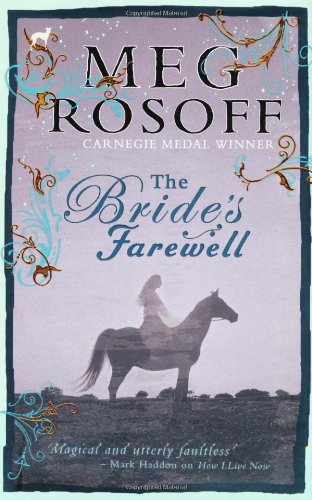
Review: "The Bride's Farewell" by Meg Rosoff.

“The Bride’s Farewell”

Author: Meg Rosoff.

Publisher: Puffin.

Pages: 192.

Synopsis (taken from GoodReads): On the morning of her wedding, Pell Ridley creeps out of bed in the dark, kisses her sisters goodbye and flees — determined to escape a future that offers nothing but hard work and sorrow. She takes the only thing that truly belongs to her: Jack, a white horse, and small mute Bean who refuses to be left behind.

The road ahead is rich with longing, silence and secrets, and each encounter leads her closer to the untold story of her past. Then Pell meets a hunter, infuriating, mysterious and cold. Will he help her to find what she seeks?

With all the hallmarks of Meg Rosoff’s extraordinary writing,The Bride’s Farewell” also breaks new ground for this author, in a nineteenth-century, Hardyesque setting. This is a moving story of love and lost things, with a core of deep, beautiful romance.

Cover impressions: I love Meg Rosoff’s work. “How I Live Now” and “Just In Case” were refreshing and vibrant, with a fascinating layer of unease throughout the simple but highly effective prose. Both books received mass acclaim, both from teens and adults, and many literary awards, such as the Carnegie Medal and Printz Award. I highly recommend her first two books to anyone in search of a book that proves YA can be just as moving, surprising and intriguing as anything intended for adults. Unfortunately, I cannot say the same thing for “The Bride’s Farewell.”

As always, Rosoff’s prose is wonderful, managing to be deceptively simple but striking and void of overt sentimentality. It’s certainly the strongest thing about this short book but great prose isn’t enough to make a story worthwhile. After a strong start and the initial establishment of a strong, independent heroine, the story quickly loses momentum and dissolves into many paragraphs of exposition and summaries more suited to a “Previously on...” introduction to a TV series than a novella. There is no real strong narrative to the novella; instead, we are left with chapter after chapter describing each unconnected thing Pell does, occasionally meandering off for a little exposition on a barely developed character of no real importance. I can’t blame the short length of the story for this since many wonderful novellas and short stories have been written before this that manage to get in ten times more characterisation and plot. Pell’s introduction started off so strong but quickly fell apart as it felt like Rosoff became bored with her own story and characters. So little time is spent allowing Pell to grow – and the few decisions she does make later on seem at direct odds with her early characterisation - and by the end of the book I felt apathetic towards her fate. I had similar feelings, or lack thereof, towards the supporting cast, who are so thinly drawn they’re transparent. Many of these characters also veered wildly into caricature territory. Almost every man in the story is a philandering drunk who does not care for his numerous children, while anyone who openly talks of faith and God is usually a ranting fool with no regard for kindness or basic human decency. Not only were such descriptions borderline offensive, they were also plain lazy. When the reader is asked to sympathise with one particular case – a man who abandoned his wife and child and only comes back to see his son to teach him to ‘be a man’ and hunt – because he becomes the designated love interest, it’s hard to stomach.

My biggest problem with the book came with the story. As I said before, there really is no strong narrative structure to “The Bride’s Farewell” as Pell meanders from one place to another, but almost everything that happens in this story is misery porn. If something’s going to go wrong then chances are it will. Pell is mistreated, mocked, left to starve, robbed, cheated, the whole shebang. Almost every woman that Pell encounters, no matter how long they appear for, immediately mistrusts her or believes her to be out to steal their men with her beauty, another lazy character element that left me with a bad taste in my mouth. I am fine with unflinching unsentimentality, many writers have made masterpieces from such plot choices, but here it feels lifeless and completely pointless. Pell doesn’t grow as a character because of these events, she doesn’t become a stronger person (actually, I think she becomes even more downtrodden and submissive than before), so to pack this short book with such defeated angst for no reason feels like bad storytelling. It’s such a disappointment because I know Rosoff is capable of brilliance.

Someone asked me if it was worth reading a bad book if it had one truly wonderful redeeming feature, in this case the prose. Even though I think Rosoff is a wonderful writer and her prose is always strong, in the case of “The Bride’s Farewell”, it’s just not worth it. Great prose cannot singlehandedly support lazy characterisation, clumsy plotting and a story that seems more concerned with making its characters miserable than allowing them to truly grow. I cannot recommend Rosoff’s other books highly enough so I recommend you pick those wonderful pieces of YA up to read instead of this one, which I hope is merely a minor speed bump in her career.

2/5.

  • Digg
  • Del.icio.us
  • StumbleUpon
  • Reddit
  • RSS

Review: "The Girl in the Steel Corset" by Kady Cross.

“The Girl in the Steel Corset.”

Author: Kady Cross.

Publisher: Harlequin Teen.

Pages: 477.

Synopsis (taken from GoodReads): In 1897 England, sixteen-year-old Finley Jayne has no one…except the "thing" inside her. When a young lord tries to take advantage of Finley, she fights back. And wins. But no normal Victorian girl has a darker side that makes her capable of knocking out a full-grown man with one punch….

Only Griffin King sees the magical darkness inside her that says she's special, says she's one of them. The orphaned duke takes her in from the gaslit streets against the wishes of his band of misfits: Emily, who has her own special abilities and an unrequited love for Sam, who is part robot; and Jasper, an American cowboy with a shadowy secret.

Griffin's investigating a criminal called The Machinist, the mastermind behind several recent crimes by automatons. Finley thinks she can help—and finally be a part of something, finally fit in. But The Machinist wants to tear Griff's little company of strays apart, and it isn't long before trust is tested on all sides. At least Finley knows whose side she's on—even if it seems no one believes her.

Cover impressions: There’s been much talk amongst the blogosphere of a possible upcoming Steampunk craze in YA, in the wake of Cassandra Clare’s best-selling but incredibly mediocre foray into the genre. Kady Cross, the pseudonym for author Kathryn Smith, mentions in the acknowledgements for her book that she wanted to write a cross between “X Men” and “The League of Extraordinary Gentlemen.” As a fan of both (I have a serious guilty pleasure love of the latter movie adaptation, even though I’m perfectly aware of how bad it is) I approached this with cautious optimism but, after a great opening chapter, found myself quickly bored.

The potential for greatness is definitely there but these promising elements are put together so clumsily and in such a derivative fashion. The love is always in the details, and such things are genre expectations for Steampunk – it’s not just about shoving in some cogs and corsets and calling it a Steampunk novel, you have to create the entire world in all its depth and intricacies. Unfortunately, this novel tries to throw in so much detail that basic elements of storytelling such as plotting and pacing suffer. There’s just so much stuff to be described and Cross does so frequently and it weighs down the pacing until its dead in the water. There’s so much technology on show, so many paragraphs on the intricacies of a piece of equipment that it quickly becomes exhausting, especially when the story seems to have disappeared. It’s such a shame because the story starts with an intriguing bang that promises much but doesn’t quite deliver. The world never really feels like a well constructed alternative Steampunk universe. Instead, it’s more like a Victorian set romantic mystery with some stuff thrown in. I did find a lot of the technology interesting but its place in the story felt forced and shoe-horned in, never organic to the proceedings. Like the story itself, much of this technology is told to us and not shown.

It’s also a disappointment to see how many of the YA paranormal tropes this book falls into. The love triangle, for unfortunately there is another one in a YA novel, is the typical series of events we’ve come to expect in this genre, with little development of the actual characters Finley is supposed to be so taken by. Finley herself was another example of squandered potential. Her genuinely interesting issues were plodded out in such a pedestrian manner that, like everything else in the story, I quickly became bored by her. The mystery that has much more interesting potential than the love triangle is sacrificed for the romance, although what little mystery we were given was a little too predictable. I couldn’t help but shake the feeling that this story wasn’t complete. I know it’s the first in a planned trilogy but on its own, “The Girl in the Steel Corset” felt half-done. I later found out that Cross had released an online prequel to the book which leaves me with mixed feelings I may have to address in a later blog post.

“The Girl in the Steel Corset” is another example of great potential sadly squandered, and not the Steampunk YA saviour one was hoping for. There are moments of excitement and interest amidst the plodding story and tedious pacing but it never really amounts to something worthwhile. The basic idea of the story is definitely one with possibilities, so I hope Cross can expand upon them and iron out the story’s weaknesses in the rest of the trilogy.

2/5.

"The Girl in the Steel Corset" will be available in USA on May 24th. I received my e-ARC from NetGalley.com.

  • Digg
  • Del.icio.us
  • StumbleUpon
  • Reddit
  • RSS

Review - "The Eternal Ones" by Kirsten Miller

“The Eternal Ones”

Author: Kirsten Miller.

Publisher: Penguin Razorbill.

Pages: 416.

Synopsis (taken from GoodReads): Haven Moore can't control her visions of a past with a boy called Ethan, and a life in New York that ended in fiery tragedy. In our present, she designs beautiful dresses for her classmates with her best friend Beau. Dressmaking keeps her sane, since she lives with her widowed and heartbroken mother in her tyrannical grandmother's house in Snope City, a tiny town in Tennessee. Then an impossible group of coincidences conspire to force her to flee to New York, to discover who she is, and who she was.

In New York, Haven meets Iain Morrow and is swept into an epic love affair that feels both deeply fated and terribly dangerous. Iain is suspected of murdering a rock star and Haven wonders, could he have murdered her in a past life? She visits the Ouroboros Society and discovers a murky world of reincarnation that stretches across millennia. Haven must discover the secrets hidden in her past lives, and loves¸ before all is lost and the cycle begins again.

Cover impressions: I am very picky about my romances, especially when it comes to the notorious minefield that YA romances has become. With the paranormal YA genre populated with instant love, jerkiness masquerading as love, tragic live with no consequences, obsessive love and stalking as love, it’s all become a little depressing. With “The Eternal Ones” we have an emphasis on reincarnation with romance, something that was touched upon with disastrous incompetence by Lauren Kate in “Fallen.” When I was working in a bookshop last Christmas, the employees were allowed to take home some of the ARCs that were sent into the store and I was lucky enough to get an ARC of this book but it’s taken me a long time to actually finish reading the book.

Reincarnation as a central theme in a story is an idea with fantastic potential but said potential can also be mishandled very easily. It’s all too easy to use it as a get-out-of-characterisation-and-development-free card and I’m afraid that’s what “The Eternal Ones” does for the larger part of the story, which is a shame because the initial set-up was intriguing: a young woman in a claustrophobic small town with traditional beliefs and old fashioned scare mongering coupled with her confusion over her visions and what they all mean could have been something genuinely gripping in the tradition of the Southern gothic, a genre I am a complete sucker for. Haven, cheesy name choice aside, starts out an interesting enough heroine, and the small town residents well rounded enough to keep the story going, although there are moments where they’re seriously at risk of falling into caricature territory, but the moment Iain enters the equation, it goes downhill very quickly.

There’s no development between Haven and Iain as lovers. They meet face-to-face about a hundred pages in and that’s that. While Miller tries to throw a few red herrings and speed bumps in the way of their relationship, they offer no real depth to the characters and actually served to make me dislike the couple more and more as the story progressed. Haven showed brief moments of strength and backbone but all too often she fell into stupid mode and blindly accepted Iain’s explanations even when she knew they were lies. I’m not sure how everyone else feels but I can’t be the only one who is sick of the so called hero constantly lying and keeping important secrets from his supposed love to ‘protect her’ and ‘keep her safe’, when just keeping her up-to-date on what’s happening would surely be of more use to her. Iain doesn’t come across as a gallant hero or love for the ages; he just comes across as an entitled jerk. The reincarnation element seemed like such a cheap move to pull in lieu of real development between Haven and Iain – they already know each other and loved each other in a previous life as different people so why get to know each other in this life? Because people obviously never change. Haven’s jealousy over Iain’s playboy reputation is apparently one of the reasons he loves her over their many lifetimes together, which I found to be an odd thing to like about someone. Surely such emotions aren’t a strong foundation for a relationship? There was no real fire or heat between the pair, let alone trust or mutual respect.

The plot, with its numerous red herrings and pointless dead ends that added nothing to the story, was serviceable but far too long. At over 400 pages, a stringent editor could have done wonders with the story and streamlined it more for a quicker paced read. The lack of serious development over these pages was also disappointing, especially since the potential was limitless. I found myself imagining new ways to write the story; Haven being unsure whether her visions are real, the result of madness or possession, the conflict between religion and medicine in a small, suspicious town, the conflict between religions (a brief scene involving Haven visiting a different church with a friend revealed some interesting possibilities) and the difficulties between Haven, her family and the town’s residents, etc. Some ambiguity could have done this story wonders, but everything was so clean cut and even when doubt was thrown into the equation, one never fully believes that there’s any true alternative to the designated storyline.

Haven’s visions also suffered from the typical path of magical powers in YA in that they only showed up when it was convenient to the plot and only just revealed enough to keep Haven in the dark at all times. It became rather annoying after a while. Outside of the breeding pair, the supporting cast ranged from interesting (Haven’s friend Beau was sweet and their friendship didn’t feel too forced) to clichéd (the town preacher who had potential to be much scarier than he was) and cardboard cut outs (Haven’s fiercely religious grandmother was a shrill, two-dimensional figure with potential – I keep using that word – to be so much more). The ending does pick up the pace, with the villain of the piece finally turning up a little late to the table, and throws in a few interesting elements that I wish had been added earlier to the story, although seeing as this is the first in a series, it will be interesting to see how Miller develops his potential.

Overall, I didn’t hate this book, I just felt disappointed. It had such great potential and the prose was strong enough to support it but the plotting fell back on easy conveniences and a poorly developed romance between stock characters with no unique qualities. There is further potential for the sequel to be interesting if Miller sticks with the intriguing parts but the reliance on easy ways out left me feeling cold. Reincarnation is a fascinating idea and deserves an equally fascinating story to back it up. This just isn’t it.

2/5.

On a more shameless note, my next post on The Book Lantern, where I'll be recommending underappreciated Scottish teen fiction, should be up today so go check it out and leave a few comments on our posts!

  • Digg
  • Del.icio.us
  • StumbleUpon
  • Reddit
  • RSS