Fleeing the only home she’s ever known, Eve sets off on a long, treacherous journey, searching for a place she can survive. Along the way she encounters Caleb, a rough, rebellious boy living in the wild. Separated from men her whole life, Eve has been taught to fear them, but Caleb slowly wins her trust...and her heart. He promises to protect her, but when soldiers begin hunting them, Eve must choose between true love and her life.
The Orwell Project: 3 - "Eve" by Anna Carey.
Fleeing the only home she’s ever known, Eve sets off on a long, treacherous journey, searching for a place she can survive. Along the way she encounters Caleb, a rough, rebellious boy living in the wild. Separated from men her whole life, Eve has been taught to fear them, but Caleb slowly wins her trust...and her heart. He promises to protect her, but when soldiers begin hunting them, Eve must choose between true love and her life.
The Orwell Project: 2 - "Matched" by Ally Condie.
The Society tells her it's a glitch, a rare malfunction, and that she should focus on the happy life she's destined to lead with Xander. But Cassia can't stop thinking about Ky, and as they slowly fall in love, Cassia begins to doubt the Society's infallibility and is faced with an impossible choice: between Xander and Ky, between the only life she's known and a path that no one else has dared to follow.
The Orwell Project: 1 - "Divergent" by Veronica Roth.
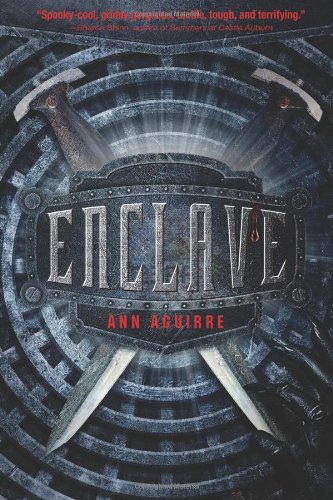
Review: "Enclave" by Ann Aguirre
"Enclave"
Author: Ann Aguirre
Publisher: Feiwel and Friends
Pages: 259
Summary (taken from GoodReads): In Deuce’s world, people earn the right to a name only if they survive their first fifteen years. By that point, each unnamed ‘brat’ has trained into one of three groups–Breeders, Builders, or Hunters, identifiable by the number of scars they bear on their arms. Deuce has wanted to be a Huntress for as long as she can remember.
As a Huntress, her purpose is clear—to brave the dangerous tunnels outside the enclave and bring back meat to feed the group while evading ferocious monsters known as Freaks. She’s worked toward this goal her whole life, and nothing’s going to stop her, not even a beautiful, brooding Hunter named Fade. When the mysterious boy becomes her partner, Deuce’s troubles are just beginning.
Down below, deviation from the rules is punished swiftly and harshly, and Fade doesn’t like following orders. At first Deuce thinks he’s crazy, but as death stalks their sanctuary, and it becomes clear the elders don’t always know best, Deuce wonders if Fade might be telling the truth. Her partner confuses her; she’s never known a boy like him before, as prone to touching her gently as using his knives with feral grace.
As Deuce’s perception shifts, so does the balance in the constant battle for survival. The mindless Freaks, once considered a threat only due to their sheer numbers, show signs of cunning and strategy… but the elders refuse to heed any warnings. Despite imminent disaster, the enclave puts their faith in strictures and sacrifice instead. No matter how she tries, Deuce cannot stem the dark tide that carries her far from the only world she’s ever known.
Cover impressions: After receiving a copy of this book from GoodReads friend Lucy, I was immediately drawn to the Publisher’s Weekly quote declaring the book to be “for fans of The Hunger Games”. Such comparison quotes, while attention grabbing and common practice amongst publishers, immediately set up a certain level of expectations, even in the most cynical of readers. While I haven’t actually finished reading The Hunger Games yet (I’ll get round to it eventually, I swear!), I began this book with the same expectations I have for every dystopian novel – strong world-building and a real threat & sense of danger.
There are books that make me consider discarding use of the flawed star rating system for reviews. Sometimes it’s close to impossible to summarise the qualities of a book into a simple rating out of 5, 10 or however one chooses to do so. A book can be a relatively enjoyable and competently written piece of work that would otherwise deserve a solid rating, but a certain element, event, etc, can bring its rating tumbling down. This happened to me with Sarah Beth Durst’s “Ice” and it happened with “Enclave”. But before I get to why I cannot give this book anything higher than one star, I shall discuss other elements of the book that succeed and fail.
I’m sure you’re all sick of me going on and on about this but the foundations of a strong dystopian novel lie in its world-building. Unusual or disturbing events can’t just happen for shock value. They need to be rooted in the origins of the society, grounded in reason, meaning the reason of this world. This fundamental lack of reason within the world-building in “Enclave” left more than a few questions unanswered. The underground society Deuce lives in does not name its young, known as brats, until a specific age, which is never mentioned. Why? There doesn’t seem to be any specific reasoning behind this rule and seems too impractical to fit in with a world that works to prove itself as fundamentally practical. There are hints of a cult-like mentality to the ruling class of the world but it’s barely touched upon and leaves us with half-built reasoning. Children are sanctioned into one of three groups – warriors, builders or breeders – yet the reasons for specific grouping once again seem at odds with the necessary practicality & needs of this society. One breeder, Deuce’s friend, is seen as ideal for his calling because he is handsome, but I failed to see why this would be a relevant quality in a world where death & disease are rampant. Other extremely questions go unanswered – how does this enclave have clean water after generations underground? How does Deuce go from a lifetime underground to full on exposure to sunlight and only get slightly burned with no damage to her eyesight?
The writing itself is adequate, if simple, and has well-paced action scenes, although the overall pacing is erratic. Certain scenes are evident padding and clumsy plotting, which coupled with several under-developed plot points proves to be somewhat frustrating. No character other than the heroine is given adequate time to develop beyond basic tropes, although I did warm to Deuce somewhat throughout the first half of the novel. However, it is one particular character and how others react to him that soured things for me.
A little more than midway through the novel, Deuce is kidnapped by a gang who make their intentions towards her clear – they intend to use her for breeding purposes, forcefully if need be. Later we are introduced to Tegan, a fellow kidnapped woman who has been raped repeatedly and given birth to stillborn children. After altercations with the story’s main monsters, the Freaks, the head of the gang, Stalker (yes, really), decides he will go along with Deuce, Tegan and main love interest Fade in order to have a better chance of surviving. Fade and Deuce agree to this, despite Tegan’s protests that she does not feel safe around the leader of the gang of rapists who repeatedly violated her for years. Later on, Stalker pushes Deuce against a tree and kisses her.
Deuce reciprocates.
I’ve made my thoughts clear on the ‘bad boy’ trope in YA; I don’t like it. I understand the fantasy behind being the one girl who changes the rebel but ultimately I think it’s a problematic trope that is all too often used as an excuse to have the love interest treat the heroine like dirt, often being rough with her and belittling her.
Patch from “Hush Hush” held his love interest against a bed and talked about how much he wanted to kill her after stalking her, harassing her and generally making her feel uncomfortable and unsafe.
Stalker is the leader of a gang of rapists. It is hinted at in the book that he has raped women before. It is also implied that he may have raped Deuce during her kidnapped period.
He is presented as a potential love interest to Deuce.
The aim of a good dystopian novel is to create a sense of dread. I have seen rape mentioned in other dystopian novels and within the constraints of this world where humans die young and need to reproduce quickly, it makes sense that a patriarchy dominated society would view women in such a manner. However, I have never seen rape used so casually and tossed aside so simply by a character and an author in a YA novel. There is a cruel lack of empathy for Tegan in “Enclave”. Even within the constraints of the novel’s world, one ruled by social Darwinism, to force Tegan to interact daily with the man who stood by & let her be raped repeatedly, possibly ordering the rapes himself or even engaging in the horrific act himself, is baffling at best and disgusting at worst. As the novel progresses, Tegan grows (lazily from a characterisation point-of-view) from a victim into a ‘strong’ young woman who can fight back, but all I could think about was how her rape was used in such a cavalier fashion. Deuce, who started off with such potential (even if she did fall into the typical romantic plot tropes with mysterious bad boy Fade), does not question Stalker or his past actions. Instead, she lays some of the blame on Tegan. The dismissive attitude she has towards a victim of multiple rapes is abhorrent. At one point she asks herself how Tegan could have been so weak as to allow the events to happen. Deuce’s general attitude is that life is tough, and if she can suck it up and get on with her life, so can Tegan. Even within the context of the novel, this felt wrong on every level. Deuce, who had previously shown moments of true empathy, becomes someone who sympathises more with a rapist than the victim of rape. I shouldn’t even have to explain why this made me sick. And that’s why I can’t give this book anything more than one star.
I don’t expect every book in the world to be a beacon of social justice and feminism; that would be stupid. What I do expect is for a book to follow the rules it sets for itself. “Enclave” fails on this thanks to its inconsistent and confusing choices in its world-building, which seem to exist more for shock value than any real sense of reason. It’s a mediocre novel that becomes disgusting when something as serious, life changing and horrific as rape is used so clumsily. Rape is NEVER the woman’s fault. She’s never ‘asking for it’ and she’s certainly never deserving of pity or scorn because she was unable to fight back. Bad boys are problematic enough, but making a rapist not only a sympathetic character, one who receives a degree of sympathy from the heroine not rewarded to the victim, but a potential love interest is flat-out inexcusable.
1/5.
Review: "The Pledge" by Kimberly Derting.
“The Pledge”
Author: Kimberly Derting.
Publisher: Margaret K. McElderry.
Pages: 320.
Summary (taken from GoodReads): In the violent country of Ludania, the language you speak determines what class you are, and there are harsh punishments if you forget your place—looking a member of a higher class in the eye can result in immediate execution. Seventeen-year-old Charlaina (Charlie for short) can understand all languages, a dangerous ability she’s been hiding her whole life. Her only place of release is the drug-filled underground club scene, where people go to shake off the oppressive rules of the world they live in. There, she meets a beautiful and mysterious boy who speaks a language she’s never heard, and her secret is almost exposed. Through a series of violent upheavals, it becomes clear that Charlie herself is the key to forcing out the oppressive power structure of her kingdom….
Cover impressions: The more YA books I see being released amidst the continuing dystopia trend (a fad that seems to have a lot more mileage than I originally anticipated, although the sales figures are a more mixed bag), the more I find myself questioning what makes a book dystopian. With “The Body Finder” author Kimberly Derting's latest, the first in a planned trilogy, I hesitate to call it, for lack of a better term, pure dystopian since it mixes more fantastical elements into the story. This discussion aside, what elements that the book uses that are clearly in a dystopian vein are unsuccessful.
The setting, the country of Ludania, is frequently described in terms of its oppressiveness and constant threat of danger but neither of these things were shown on the page. For a supposedly highly guarded society, there was a lot of freedom allotted to its residents. There seemed to be no real adult supervision of the secret club visiting teenagers, except for a few guards now and then, but when one of the characters is described as using heavily guarded security check-points as an opportunity to practice her flirting techniques, it sort of detracts from the sense of fear and urgency. This is an issue I've had with a few dystopian YA novels in recent times. We're frequently told of the dangers and need for constant vigilance but what we are presented with is a series of plot convenient instances and loopholes that detract from the atmosphere needed to create a truly tense story. A strong sense of urgency and fear is a must for dystopian set stories, in my opinion. On top of all this, Derting includes a more fantasy oriented element that is the driving force behind the central premise of the story. Charlie can understand every language, a dangerous skill in a world where social groups are broken up by which language they speak. As a student of semi-dead languages, this premise was a potential gold-mine for me, and I think there is a genuinely interesting world to be built from the idea of using language as a device of socio-political matters. Unfortunately, this book isn't it. The strong idea is never fully built upon, a matter made all the more frustrating thanks to the complete lack of detail given when it is used. The book was a step away from saying “It's magic, we don't have to explain it”, which is never a good answer.
The characters are as shallow as the plot, in particular the heroine Charlie and the first designated love interest Max (there are at least 3 men in the story who I thought could be potential love interests because they are constantly described by way of their handsome looks and enticing aura by Charlie. She may have claimed that her friend Brooklynn was the boy crazy one but she seemed just as single-minded). Neither rises beyond the stock YA romance traits, with Charlie's passiveness being extremely grating but not as much as Max's frequently rude, condescending and smug behaviour being written off as okay because he's so enamoured with a girl he's known for barely a few weeks – the book has a very short time-line – and makes her so weak at the knees I'm surprised she could perform basic human functions. It's yet another YA where the breeding pair fall into the typical gender roles. Maybe it's because I'm jaded and I've been reviewing these sorts of books for what feels like an era, but when the romantic hero, who has only personally known the heroine for a couple of weeks (there are references that he's had his 'protective' eye on her for longer), and he says “All I want is to keep you safe... it's all I've ever wanted”, alarm bells go off in my head. His case isn't helped by his frequent grabbing of Charlie as if he's allowed to do this because we all know they're going to end up together.
“The Pledge” is a slow, mediocre book that shows a glimmer of promise for the rest of the series in the final few pages, but it's not enough for me to feign further interest. To see such potential wasted is a disappointment, made all the worse by the continuing trend for the sort of romances that make me want to pull my hair out. While the prose itself is serviceable, the constant switching of narratives from Charlie's 1st person to several characters's 3rd person points-of-view felt unnecessary given the lack of distinguishing features given to them. My biggest issue with the book is that it's so shallow. Nothing is given the depth required to make the story fully engaging – the world building is slack, the characters are stock, the romance is tired and predictable and the much needed tension is nowhere to be seen.
2/5.
"The Pledge" will be released in USA on November 15th 2011. I received my ARC from Simon & Schuster's Galley Grab programme.
Review: "Delirium" by Lauren Oliver.
“Delirium”
Author: Lauren Oliver.
Publisher: Hodder & Stoughton.
Pages: 393.
Summary (taken from GoodReads): Before scientists found the cure, people thought love was a good thing. They didn’t understand that once love -- the deliria -- blooms in your blood, there is no escaping its hold. Things are different now. Scientists are able to eradicate love, and the governments demands that all citizens receive the cure upon turning eighteen. Lena Holoway has always looked forward to the day when she’ll be cured. A life without love is a life without pain: safe, measured, predictable, and happy.
But with ninety-five days left until her treatment, Lena does the unthinkable: She falls in love.
Cover impressions: While the dystopian YA craze has been heavily promoted and much talked about this year, it has arguably not met the extremely high expectations placed upon it by publishers and readers. Sales have been mixed with only a couple making it into the New York Times bestsellers list – “Matched” by Ally Condie, the recently released “Divergent” by Veronica Roth and Lauren Oliver’s “Delirium”, the first in a planned trilogy (as are the previously mentioned books.) It’s also worth noting that all three books were arguably the most heavily publicised dystopian YAs of the year. “Delirium” also comes with the added bonuses of being a new book from an author with much critical acclaim for her first book, “Before I Fall” (which I haven’t read) as well as a heavily promoted romantic angle, which has proven popular. For me, a dystopian novel rises and falls on its world building and the atmosphere the society within the novel evokes. I always associate a great dystopia with fear, paranoia, confusion, a constant sense of foreboding. Unfortunately, “Delirium” gave me none of this, but with the basic premise being such a bewildering one, it’s not hard to see why.
The front cover of the book asks “What if love were a disease?” And immediately, I ask questions. I can understand a dystopian society where emotions have been suppressed and declared dangerous. Lois Lowry executed that premise with particular skill in “The Giver.” However, the idea that of all the emotions in the world that could be considered the most dangerous to our world, the ones that cause the most damage and war, love is the worst is just confusing to me. What about greed? Anger? Fear? The book does little to expand upon the dangers of love, and the pseudo-science we are given does little to convince. Add to that the sheer number of plot holes and it was difficult to completely immerse oneself in this world. I started asking questions on the 2nd page. Why is the procedure to cure one of the symptoms of love ineffective to the under 18s? Why are uncured boys and girls kept separate but it’s okay for Lena, our incredibly passive and dull heroine, to associate with a cured man? Did nobody stop to think that raising children who are capable of love with parents who are not was a bad idea? If segregating the sexes is supposed to prevent early onset love then what about gay boys and girls? Why is it so easy for uncured citizens to pass themselves off as cured? Surely there would be more rigorous testing or such. These aren’t even all the questions I found myself asking throughout the course of the book.
The world itself is also very sloppily built and does not evoke the emotions of fear that Oliver intends it to. For a society that’s supposed to be rigorously guarded and watching its citizens at all times, it’s pathetically easy for characters to go to secret parties, to sneak into the forbidden areas, to let animals into government buildings. While Oliver does use an interesting narrative device in having each chapter start with an excerpt from the fictional literature of the book’s world, they do little to evoke what this society is really like. On top of all this, we’re never given any real history behind the USA’s decision to implement this ban on love. There’s no moment given to us where, for example, a civil war of sorts was declared between love and non love (anyone else hearing songs from “Hair” in their head?) to justify this change in power. With “1984”, Big Brother was always watching you. In “Delirium” things are decidedly more meh-ish. The best dystopians, although not all of them, take something from our world and take it to its worst conclusion, a cautionary tale of sorts. I could imagine the USA implementing an authoritarian, anti-woman society like “The Handmaid’s Tale”. I could imagine a mass government takeover founded in an extremely fringe religious movement. I can’t imagine love being declared a disease.
As expected with a book based on the idea of discovering one’s own awareness of love and the emotion itself in action, our heroine Lena has moments of extreme melodrama. While these moments would be understandable had her society and plight been more believable, here I was just left cold. None of the other characters really stood out in any way for me. The love interest Alex was particularly bland, once again another amalgam of every YA romance male love interest I’ve ever read; a bit of a jerk, constantly saving Lena, reciting love poetry, never going beyond surface detail with the romance. For a book that relies so heavily on the idea that true love is something so wonderful that it’s worth risking your life for, I never thought of Lena and Alex’s romance as anything more than teenage necking. Of course, it was also tough for me to sympathise with the pair when they wax lyrical about how romantic and beautiful a love story “Romeo & Juliet” is. Yes, this is another YA novel that completely misreads and oversimplifies the famous play, but it’s made even worse by the evil, love hating society decreeing it to be a cautionary tale, which it is, but of course Lena and Alex know the truth. While I give Oliver credit for not completely following the well worn path of YA romance, for the most part their relationship is everything one would expect from such a book.
Oliver’s real strength lies in her prose. It’s well structured and very purposeful. I got the feeling that, had Oliver had a stronger story and characters, this book would have been much more effective. As it is, “Delirium” is a long, confusing and often very dull read. I don’t think the premise is a completely terrible one but it’s one that requires very deep analysis and a meticulously thought out society to build upon it. Strong prose will only go so far when it’s trying to keep sloppy world building, a tough premise and weak characters afloat. In the end, “Delirium” left me with far too many questions and not enough satisfaction.
2/5.