Followers

Powered by Blogger.
RSS
One highly opinionated feminist YA nerd's twisted, snarky and informative journey through the genre's perils, pitfalls and sparkles.
Showing posts with label paranormal romance. Show all posts

Review: "Between the Sea and the Sky" by Jaclyn Dolamore.

Between the Sea and the Sky”

Author: Jaclyn Dolamore.

Publisher: Bloomsbury Children's Books.

Pages: 240.

Summary (taken from GoodReads): For as long as Esmerine can remember, she has longed to join her older sister, Dosinia, as a siren--the highest calling a mermaid can have. When Dosinia runs away to the mainland, Esmerine is sent to retrieve her. Using magic to transform her tail into legs, she makes her way unsteadily to the capital city. There she comes upon a friend she hasn't seen since childhood--a dashing young man named Alandare, who belongs to a winged race of people. As Esmerine and Alandare band together to search for Dosinia, they rekindle a friendship . . . and ignite the emotions for a love so great, it cannot be bound by sea, land, or air.

Cover impressions: I found Dolamore's debut “Magic Under Glass” to be a charming and creative book that could have benefited from some tighter plotting and characterisation. It certainly sparked my interest for her next book, a standalone mermaid story, especially after Dolamore mentioned how she wrote the book to the scores of Studio Ghibli films (indeed, I noted in my earlier review how her creative worlds would be ideal for Hayao Miyizaki's next film.) While the mermaid craze never quite took off the way that many bloggers and publishers thought it would, there is still a gap in the market for a strong mermaid YA to join the myriad of vampires, werewolves, angels and other assorted creatures of mythology already so well known to readerrs. Unfortunately this book did not meet my excpectations.

I found that many of the same problems I had with Dolamore's previous novel appeared in “Between the Sea and the Sky”. Wonderfully imaginative elements of world-building, including the mermaid-siren hierarchy, the relations between each of the species and the world of the winged creatures, the Fandarsee, were introduced to us but never fully developed. In “Magic Under Glass”, Dolamore introduced the strands of political and cultural complexities that I was desperate to know more about, yet such elements never came to fruition, and the exact same thing happens here. While there were moments of vivid descriptive scenes throughout her consistently strong prose, I never felt fully immersed in the world-building. To be honest, much of it felt very underdeveloped. I have a feeling this book may be marketed to a younger, more middle-grade audience. The prose and story-telling feels more suited to pre-teen readers, although it's very readable for all ages. I did find that the frequent dumping of exposition began to grate extremely quickly, especially since this is such a short book with very little action and a highly predictable plot.

I did not find Esmerine to be as interesting or well developed as Nimira in “Magic Under Glass.” The idea of the young beautiful mermaid dissatisfied with her lot in life and yearning for more on the surface is nothing new. In fact, it's a staple of the great mermaid tales going back as far as Hans Christian Andersen, maybe even further. I can understand the harking back to influential tales but so little is developed from that point onwards that it can't help but feel stagnant and unsatisfying. This applies to pretty much every supporting character in the book, although nobody is ever really given any real time to shine or become more three-dimensional. Of course, this doesn't bode well for the romantic element, which felt too heavily reliant on the childhood friends trope to explain Esmerine and Alandare's relationship. One part of the book that really left me scratching my head was the depiction of humans. While mermaids and the Fandarsee are granted some variety of characterisation, pretty much every human is seen as selfish, rude or extremely ignorant of other species aside from themselves. They seem to view all others as a side-show novelty. I could understand this possibly for one or two characters from more isolated parts of the country, but these interactions and knowledge of other creatures are well known, so it didn't make much sense to have every human act like a fool when in the presence of a mermaid (whom they are especially susceptible to falling under their charms) or Fandarsee.

While “Between the Sea and the Sky” possesses much of the charm and imagination of Dolamore's debut work, the same flaws are also still present and overwhelm the positive elements. Wonderfully creative elements and ideas are introduced but left to flounder instead of being given their deserved attention, while the characters and romantic element are pretty stock for the genre for the most part. The readability of its prose and short length make it ideally suited to younger readers, although the book itself is not without merit for readers of all ages. Once again, it's an ideal framework for a Ghibli film, but also hints are Dolamore's possible strengths as a short story writer.

2.5/5.

  • Digg
  • Del.icio.us
  • StumbleUpon
  • Reddit
  • RSS

Review: "White Cat" by Holly Black.

“White Cat”

Author: Holly Black.

Publisher: Gollancz Fiction & Orion Publishing Group.

Pages: 310.

Synopsis (taken from GoodReads): Cassel comes from a family of curse workers — people who have the power to change your emotions, your memories, your luck, by the slightest touch of their hands. And since curse work is illegal, they're all mobsters, or con artists. Except for Cassel. He hasn't got the magic touch, so he's an outsider, the straight kid in a crooked family. You just have to ignore one small detail — he killed his best friend, Lila, three years ago.

Ever since, Cassel has carefully built up a façade of normalcy, blending into the crowd. But his façade starts crumbling when he starts sleepwalking, propelled into the night by terrifying dreams about a white cat that wants to tell him something. He's noticing other disturbing things, too, including the strange behavior of his two brothers. They are keeping secrets from him, caught up in a mysterious plot. As Cassel begins to suspect he's part of a huge con game, he also wonders what really happened to Lila. Could she still be alive? To find that out, Cassel will have to out-con the conmen.

Cover impressions: Holly Black is the anti-Cassandra Clare. While Black’s series has been using cover quotes from Ms Clare (a good friend of Ms Black) to promote the series, Black’s writing stands leaps and bounds beyond anything Clare has ever written and “White Cat” is a brilliant read on pretty much every level.

It’s not often these days that I’m surprised by a YA book. Maybe it’s the market itself, maybe it’s my own YA oversaturation, but whatever the case may be, when a YA comes along that I find entertaining, creative, exciting, witty and mysterious and makes it all seem so effortless, I can’t help but get excited. (The book is classified as YA by some and adult sci-fi/fantasy by others, but since it was in the YA section of my library, I’ll classify is as such.)

Even if crime based novels aren’t your thing, I highly recommend this book. Taking the concept of underground crime families and adding magic to the equation, Black has created an exciting, detailed world full of depth and intrigue, populated by a wide variety of interesting characters and genuine surprises. There’s a definite Sopranos-style vibe throughout the novel, as double crossing and black market jargon are casually discussed, but it fits in wonderfully with a well crafted and extremely readable mystery. How refreshing to see this sort of story in YA where the stakes are genuinely high and things are at true risk. The pacing is quick and smooth, even during quieter moments where Black skilfully manages to avoid turning discussions into info-dump sessions. The way the crime world is intertwined with the magic element is almost seamless and I was particularly fascinated by the different types of magic workers and how their gifts are also curses. Black’s writing style is very much suited to this type of story; it’s crisp, often sparse, very witty and avoids any sort of unnecessary visits into the town of purple prose.

The narrator of this tale, Cassel Sharp, is a joy. That sounds like an exaggeration but hear me out. One, he actually sounds like a man. Two, he manages to be tortured and scared without ever becoming whiny or overwrought, which is no easy feat. His familial interactions are interesting and never quite what they seem (The Sharps themselves are a colourful bunch, all with their own secrets and problems with so much at stake.) Three, he actually grows and develops as a character! He’s a witty, sneaky and extremely intelligent man but he’s also confused, scared and haunted by his past. His family are hiding things from him, he’s hung up on his ex-girlfriend, he’s desperately trying to con his way back into school and then there’s those dreams that plague him. Everything is handled with skill and wit. He’s definitely one of the best protagonists in YA right now. It’s also incredibly refreshing to see the small romantic element of the story not completely overwhelm the plot. It’s something that’s definitely on Cassel’s mind but he’s got other things to worry about and he knows how to prioritise! Outside of Cassel, I had a huge soft spot for his grandfather as well as his mother. She’s only featured a few times and only ever in phone call conversations but you can feel her presence throughout the book. She’s definitely the head of the clan and it shows. I can’t wait for more of her in the sequel.

If I was to criticise anything about this book, it would be this small thing. The cons are described in great detail, which is fascinating, and Cassel frequently tells us, as do many other characters, how great they are at the job, but then they immediately screw up. It got a bit repetitive but luckily didn’t spoil this wonderful book for me. I heartily recommend “White Cat” to everyone, especially those of you who, like me, were getting a sick of paranormal YA. It’s not quite an accurate label for this series but Black excels in her field with this series, creating an intricate world with intrigue, complexities and fascinating characters, and I am thoroughly excited by the prospect of getting my hands on the sequel.

4.5/5.

  • Digg
  • Del.icio.us
  • StumbleUpon
  • Reddit
  • RSS

Review: "Ultraviolet" by R.J. Anderson

“Ultraviolet”

Author: R.J. Anderson.

Publisher: Orchard Books.

Pages: 384.

Synopsis (taken from GoodReads): Once upon a time there was a girl who was special.

This is not her story.

Unless you count the part where I killed her.


Sixteen-year-old Alison has been sectioned in a mental institute for teens, having murdered the most perfect and popular girl at school. But the case is a mystery: no body has been found, and Alison's condition is proving difficult to diagnose. Alison herself can't explain what happened: one minute she was fighting with Tori -- the next she disintegrated. Into nothing. But that's impossible. Right?

Cover impressions: I am a sucker for the dark side of literature. Growing up, I went through a massive phase of reading books about crime, serial killers and down-trodden detectives looking to solve the case, so seeing the synopsis of this book on NetGalley made it an instant must read for me. The book was surprising on many levels and it’s a real genre bender, not quite the straight forward dark thriller I thought it was going to be, but did it work?

Some of it worked rather well. It becomes evident very early on that Alison has the condition synaesthesia, where one’s senses cross over and interact in interesting ways. For Ali, this involves different numbers and letters having distinctive tastes and colours as well as some surprising experiences that occur throughout the book. I really enjoyed the way this was incorporated into the story and it provided a fascinating view of the world from a truly unique perspective. Anderson’s prose is particularly strong during these points and also rather beautiful. The more lyrical moments of prose don’t always work within the context of the story though; sometimes it felt a little jarring. It was always enjoyable to read but I questioned whether it was the right stylistic choice at these moments in time. While Ali’s narration is fascinating, it also means we sometimes don’t get a fully realised view of the world she lives in. This isn’t a problem to begin with – Anderson effectively creates a sense of foreboding and intrigue as Ali discovers what has happened – but then it goes a little off the rails, mainly because of Ali.

I didn’t mind Ali as a character. I understood her fear and sympathised with it for most of the book, plus her narration, as I said, was very lyrical and interesting at times. However, her decision making process left me feeling a little frustrated. I’m not a fan of characters avoiding the obvious for the sake of plot development. Sometimes it felt like Ali wasn’t allowed to progress because the author had decided it wasn’t time for that yet. While I understood Ali’s difficulties and worries over making certain choices, it still didn’t feel natural. I also felt like we didn’t get a lot of characterisation for the supporting players, especially Ali’s fellow patients and the mysterious Dr Faraday.

There are two small, very specific things in the book that I really want to touch upon, and to do this there may be slight spoilers.

Unfortunately, the book casually drops in one of my biggest irritants in YA fiction – the casual gay joke. One of Ali’s fellow patients, who is bipolar, makes several references to Dr Faraday being gay (he isn’t gay but the boy, whose name I have unfortunately forgotten, keeps saying he is out of jealousy, I think) and no-one chastises him for it. Ali silently expresses disapproval but nobody points out how stupid and insulting it is to casually use homosexuality as a negative marker of someone. The boy was frequently punished for saying stupid thing so why not this? It’s a small thing, I know, but I’ve seen it used so frequently in fiction without any character, or even the omniscient narration, taking the time to say it’s wrong, and it bugs me because we’ve still got this society that uses ‘That’s gay’ as some ultimate insult. Homosexuality is still somehow the acceptable insult these days.

The other problematic element I had also involves this young man forcing himself on Ali. She pushes him back, screams and makes it pretty clear that she doesn’t want this and when the boy has the audacity to be insulted by this, she say sorry. Even though she mentions in her narration that she really isn’t sorry, she still says it. She didn’t have to say it! She wasn’t the one at fault here; mental illness or not, the woman, or man, shouldn’t apologise for having someone force his or herself upon her/him! Later on, the issue is dealt with and the boy is punished but this little scene still nagged at me so I had to address it.

Overall, I like a lot of thing about “Ultraviolet.” The incorporation of synaesthesia was fascinating and well handled, providing an often beautiful and unique narration, and the set-up is intriguing for the most part. I admire Anderson for taking the book out of the comfort zone and not sticking to the well worn and seductively easy routes YA has so often been taking lately. It doesn’t always work but I was never bored by what I read, even if some of it was a little sketchily developed. The strong elements that kept me reading were let down by some weaker moments of plotting and characterisation. I’m really not sure how to rate this book. It’s either a 2.5 or a 3 out of 5. There’s definitely a lot to enjoy in the book and it’s refreshing to see something unique in the genre right now, but for all its strengths it could have definitely been stronger.

2.5 or 3/5 (apologies for my indecisiveness, I genuinely spent ages trying to pick one and couldn’t!)

“Ultraviolet” will be available to read in USA on 2nd June 2011. I received my ARC from NetGalley.com.

  • Digg
  • Del.icio.us
  • StumbleUpon
  • Reddit
  • RSS

Review - "The Eternal Ones" by Kirsten Miller

“The Eternal Ones”

Author: Kirsten Miller.

Publisher: Penguin Razorbill.

Pages: 416.

Synopsis (taken from GoodReads): Haven Moore can't control her visions of a past with a boy called Ethan, and a life in New York that ended in fiery tragedy. In our present, she designs beautiful dresses for her classmates with her best friend Beau. Dressmaking keeps her sane, since she lives with her widowed and heartbroken mother in her tyrannical grandmother's house in Snope City, a tiny town in Tennessee. Then an impossible group of coincidences conspire to force her to flee to New York, to discover who she is, and who she was.

In New York, Haven meets Iain Morrow and is swept into an epic love affair that feels both deeply fated and terribly dangerous. Iain is suspected of murdering a rock star and Haven wonders, could he have murdered her in a past life? She visits the Ouroboros Society and discovers a murky world of reincarnation that stretches across millennia. Haven must discover the secrets hidden in her past lives, and loves¸ before all is lost and the cycle begins again.

Cover impressions: I am very picky about my romances, especially when it comes to the notorious minefield that YA romances has become. With the paranormal YA genre populated with instant love, jerkiness masquerading as love, tragic live with no consequences, obsessive love and stalking as love, it’s all become a little depressing. With “The Eternal Ones” we have an emphasis on reincarnation with romance, something that was touched upon with disastrous incompetence by Lauren Kate in “Fallen.” When I was working in a bookshop last Christmas, the employees were allowed to take home some of the ARCs that were sent into the store and I was lucky enough to get an ARC of this book but it’s taken me a long time to actually finish reading the book.

Reincarnation as a central theme in a story is an idea with fantastic potential but said potential can also be mishandled very easily. It’s all too easy to use it as a get-out-of-characterisation-and-development-free card and I’m afraid that’s what “The Eternal Ones” does for the larger part of the story, which is a shame because the initial set-up was intriguing: a young woman in a claustrophobic small town with traditional beliefs and old fashioned scare mongering coupled with her confusion over her visions and what they all mean could have been something genuinely gripping in the tradition of the Southern gothic, a genre I am a complete sucker for. Haven, cheesy name choice aside, starts out an interesting enough heroine, and the small town residents well rounded enough to keep the story going, although there are moments where they’re seriously at risk of falling into caricature territory, but the moment Iain enters the equation, it goes downhill very quickly.

There’s no development between Haven and Iain as lovers. They meet face-to-face about a hundred pages in and that’s that. While Miller tries to throw a few red herrings and speed bumps in the way of their relationship, they offer no real depth to the characters and actually served to make me dislike the couple more and more as the story progressed. Haven showed brief moments of strength and backbone but all too often she fell into stupid mode and blindly accepted Iain’s explanations even when she knew they were lies. I’m not sure how everyone else feels but I can’t be the only one who is sick of the so called hero constantly lying and keeping important secrets from his supposed love to ‘protect her’ and ‘keep her safe’, when just keeping her up-to-date on what’s happening would surely be of more use to her. Iain doesn’t come across as a gallant hero or love for the ages; he just comes across as an entitled jerk. The reincarnation element seemed like such a cheap move to pull in lieu of real development between Haven and Iain – they already know each other and loved each other in a previous life as different people so why get to know each other in this life? Because people obviously never change. Haven’s jealousy over Iain’s playboy reputation is apparently one of the reasons he loves her over their many lifetimes together, which I found to be an odd thing to like about someone. Surely such emotions aren’t a strong foundation for a relationship? There was no real fire or heat between the pair, let alone trust or mutual respect.

The plot, with its numerous red herrings and pointless dead ends that added nothing to the story, was serviceable but far too long. At over 400 pages, a stringent editor could have done wonders with the story and streamlined it more for a quicker paced read. The lack of serious development over these pages was also disappointing, especially since the potential was limitless. I found myself imagining new ways to write the story; Haven being unsure whether her visions are real, the result of madness or possession, the conflict between religion and medicine in a small, suspicious town, the conflict between religions (a brief scene involving Haven visiting a different church with a friend revealed some interesting possibilities) and the difficulties between Haven, her family and the town’s residents, etc. Some ambiguity could have done this story wonders, but everything was so clean cut and even when doubt was thrown into the equation, one never fully believes that there’s any true alternative to the designated storyline.

Haven’s visions also suffered from the typical path of magical powers in YA in that they only showed up when it was convenient to the plot and only just revealed enough to keep Haven in the dark at all times. It became rather annoying after a while. Outside of the breeding pair, the supporting cast ranged from interesting (Haven’s friend Beau was sweet and their friendship didn’t feel too forced) to clichéd (the town preacher who had potential to be much scarier than he was) and cardboard cut outs (Haven’s fiercely religious grandmother was a shrill, two-dimensional figure with potential – I keep using that word – to be so much more). The ending does pick up the pace, with the villain of the piece finally turning up a little late to the table, and throws in a few interesting elements that I wish had been added earlier to the story, although seeing as this is the first in a series, it will be interesting to see how Miller develops his potential.

Overall, I didn’t hate this book, I just felt disappointed. It had such great potential and the prose was strong enough to support it but the plotting fell back on easy conveniences and a poorly developed romance between stock characters with no unique qualities. There is further potential for the sequel to be interesting if Miller sticks with the intriguing parts but the reliance on easy ways out left me feeling cold. Reincarnation is a fascinating idea and deserves an equally fascinating story to back it up. This just isn’t it.

2/5.

On a more shameless note, my next post on The Book Lantern, where I'll be recommending underappreciated Scottish teen fiction, should be up today so go check it out and leave a few comments on our posts!

  • Digg
  • Del.icio.us
  • StumbleUpon
  • Reddit
  • RSS

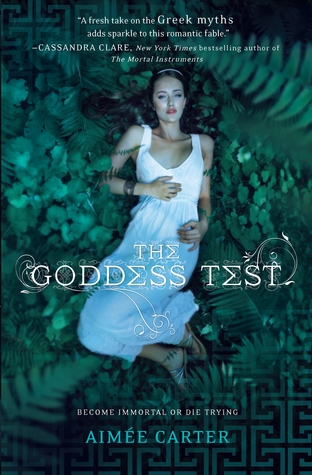
Review - "The Goddess Test" by Aimee Carter.

“The Goddess Test”

Author: Aimee Carter.

Publisher: Harlequin Teen.

Pages: 297.

Synopsis (taken from GoodReads): Every girl who has taken the test has died. Now it's Kate's turn.

It's always been just Kate and her mom--and now her mother is dying.

Her last wish? To move back to her childhood home. So Kate's going to start at a new school with no friends, no other family and the fear her mother won't live past the fall.

Then she meets Henry. Dark. Tortured. And mesmerizing. He claims to be Hades, god of the Underworld--and if she accepts his bargain, he'll keep her mother alive while Kate tries to pass seven tests.

Kate is sure he's crazy--until she sees him bring a girl back from the dead. Now saving her mother seems crazily possible. If she succeeds, she'll become Henry's future bride, and a goddess. If she fails...

Cover Impressions: I love Greek mythology. I love Greek tragedies. I love the gods and goddesses and what they all represent and the timeless stories that accompany them. As with all people who love something, I am weary with re-imaginings and modern day updates of these tales. Some can be brilliant and really update the text to fit with the modern era, others can fail miserably. I was holding out hope for Carter’s debut (with a sequel in the works) since I have always been fascinated by the Hades and Persephone myth. There’s also a number of Greek tragedy related YA books coming out soon (including the much talked about “Starcrossed” in which the author received a 7 figure advance for what is billed as Percy Jackson for girls) so my interest was piqued enough to request an ARC on GoodReads.

There was a phrase I kept using whilst reading the second half of this book – “What a dick move.” I apologise for the lack of eloquence here but it was the only thing I could think about the more this novel went on. To start off it wasn’t bad. It wasn’t brilliant and was definitely following a set pattern of mediocrity but there were a few moments I enjoyed, specifically Kate’s emotions regarding her dying mother. They were handled well and without overtly saccharine bucket-loads of cheap emotional grabs, and it was interesting to see a paranormal YA character dealing with such a difficult problem. Of course, this was quickly shoved aside for the plot, or what substituted for one.

For the first half, “The Goddess Test” wasn’t horrifically bad, it was just mediocre. It seemed to be made from a well worn mould of YA fiction – outcast heroine who immediately garners male attention, jealous female antagonist who quickly becomes friend but fits all the clichés of flighty and annoying, mysterious and tormented supernatural figure to serve as love interest, bad boy moments, technical entrapment, etc. I’d read it all before and it wasn’t anything particularly exciting. Kate and Henry’s relationship was very poorly developed and didn’t make a whole lot of sense, not to mention how decidedly dull Henry was. How can you make Hades dull? By making him a moping misunderstood bad boy, that’s how. The Hades-Persephone myth was twisted into a more teen friendly shape where Henry was made into the victim, which bugged me to no end. Then again, these characters are so un-godly it makes sense to twist the myths to fit them.

The characters are the story’s main failing for the bigger part. Kate is fine for most of it until she falls into love-struck too-annoying-to-live territory, typical for paranormal YA heroine these days it seems, and Henry is just dull. None of the immortal characters ever seem like fully fleshed out beings, let alone gods. They never convinced me that they were anything more than childish plot devices. The Greek gods could be childish but they could also be ruthless, passionate, cunning, devastatingly dangerous, charming, every other emotion you could think of. Here, the characters just served to keep the meandering plot from going too off-road.

And this was all well and good for the most part. Like I said, it was mediocre but not awful. Then we got into the second half and things changed. What made up the supposed plot and the tests that were so important in deciding whether or not a teenage girl was worthy to become an immortal and co-ruler of the Underworld and the dead become more and more contrived to the point where I was rolling my eyes every other page. Not once was I convinced that Kate was goddess material and the so-called tests just made me think that the Olympians need to hire a new manager or something. but the biggest dick move came in the final few chapters, which I am going to spoil because I was so peeved off by them that I need to share my rage.

SPOILERS BELOW.

I MEAN IT. DON’T BLAME ME IF YOU’RE SPOILED AND DIDN’T WANT TO BE.

...

Okay?

It was all a test.

I have this really big problem with books that reveal the hero/heroine is the pawn in a big game of “Fuck You, It Was All Fake.” I hate when it turns out that the character was lied to by absolutely everyone she cared about just so they could have the right results. No matter how badly contrived they are – like Patch manipulating everyone around Nora to get the right results in “Hush Hush” – or how happy the hero/heroine is with the results, I still think it’s a massive dick move to pull. How can one establish a relationship if there is no trust and never was from the beginning? That’s why I sighed “Oh, come on now!” out loud when it was revealed that everything Kate thought she knew – including HER OWN MOTHER DYING! – was constructed solely for her to take the tests to become Persephone number 2. See, Kate’s mother is one of the goddesses testing her so she was never really dying (okay, her human form was dying but she still lives on in some form.) And Kate is okay with everyone lying to her, or as they put it, hiding the truth from her to keep her safe because those are the rules. It was poorly constructed, it was incredibly contrived and it was a pure and simple dick move. It immediately destroyed any sympathies I had had with the book. I just didn’t care anymore.

“The Goddess Test” is a mediocre book, chock full of everything one expects from paranormal YA these days, with serviceable prose and a few moments that keep things going amidst the dull characters and meandering plot. But the big reveal that makes everything okay for everyone except the reader just throws my ability to care out the window and frankly, it pissed me off. Can we stop using characters, especially teenage girls, as pawns in stories? Can we treat them with a little more respect than this? I can’t recommend this book, it just doesn’t seem to care about its readers at all, be they Greek mythology fans or not. This book’s left me with the same feeling I felt the very first time I saw the infinitely superior piece of entertainment, “The Wizard of Oz”, when it’s revealed to all be a dream. That wasn’t fair.

1/5.

“The Goddess Test” will be released in USA on April 19th 2011. I received my ARC from NetGalley.com.

  • Digg
  • Del.icio.us
  • StumbleUpon
  • Reddit
  • RSS

Review - "Crescendo" by Becca Fitzpatrick.

“Crescendo”

Author: Becca Fitzpatrick.

Publisher: Simon and Schuster.

Pages: 427.

Synopsis (taken from GoodReads): Nora Grey's life is still far from perfect. Surviving an attempt on her life wasn't pleasant, but at least she got a guardian angel out of it: a mysterious, magnetic, gorgeous guardian angel. But, despite his role in her life, Patch has been acting anything but angelic. He's more elusive than ever and even worse, he's started spending time with Nora's arch-enemy, Marcie Millar.

Nora would have hardly noticed Scott Parnell, an old family friend who has moved back to town, if Path hadn’t been acting so distant. Even with Scott's totally infuriating attitude Nora finds herself drawn to him - despite her lingering feeling that he's hiding something.

Haunted by images of her murdered father, and questioning whether her nephilim bloodline has anything to do with his death, Nora puts herself increasingly in dangerous situations as she desperately searches for answers. But maybe some things are better left buried, because the truth could destroy everything - and everyone - she trusts.

Cover impressions: So... I gave in. A little bit of history: my recap/review/exasperated rant of maximum strength of Becca Fitzpatrick’s debut, “Hush, Hush”, the 3rd book in the original Sparkle Project, is probably the thing I’m most well known for. In short, I hated the book, primarily because I just couldn’t believe that the author was writing a so-called love story where Patch, the designated male love interest’s abhorrent actions, including stalking, sexual harassment, borderline abuse and threats of murder, were considered okay because he was a sexy bad boy. There is a scene in “Hush, Hush” where Patch holds Nora down on a bed and tells her how he has planned to kill her... then he kisses her. And this is all okay. I hated this book so much I threw it against a wall twice and it’s become the marker of comparison for every YA book I read in terms of bad romance. I wasn’t going to review “Crescendo” at first. After all, what would be the point? My view of “Hush, Hush” was never going to change, even if its sequel ended up being the YA equivalent of “The Dark Knight.” But the honest truth is this; I wanted to see if things got better. Or worse. Fitzpatrick has gone on the record as saying it took her 5 years to write her first book and she had no intention of writing a sequel until her agent got her a 2 book deal (she now has a three book deal with “Silence” due out this Autumn) so I wanted to see how everything changed. To be honest, I wanted to see what happened next with Patch and Nora. How exactly does one write a romance that’s so obviously dangerous and messed up and pretend everything’s okay? I saw a copy of the book in my local library and decided just to go for it.

I need to state this up front, since book bloggers are getting a bad name lately and the atmosphere in YA blogging has become really tense lately; I don’t go into books looking to write bad reviews. Even with the original Sparkle Project, my intention was to analyse a genre trend from the point of view of a feminist YA nerd and spot its problems and perils. Yes, I did it in an incredibly snarky manner which has led some people to disregard my reviews, but my intention was and still is to give the genre the analysis it deserves. It’s not a lesser, inferior mode of literature that deserves a lower opinion from readers. I didn’t go into “Crescendo” wanting to hate it. Honestly, I really wanted this to be better because I want to believe so much that one day we can stop bullshitting around and messing up perceptions of romance and relationships for teenagers. But the honest truth is that “Crescendo” is a huge disappointment, depressingly so.

The thing that worried me from the offset in this book, one chapter in (ignoring the prologue that clumsily sets up the intrigue but really gives everything away), is the establishment of Marcie, a flat, incidental character from the first book, as Nora’s ‘nemesis.’ She is immediately set up as the polar opposite of Nora based on her promiscuous dress sense. A former friend of Nora’s, she now apparently loathes her solely because “you were born.” She doesn’t get any deeper level of character development throughout the story. She’s the bad girl, the bully, the slut.

The slut. And she’s shamed at every possible moment for it. Nora, supposedly the good girl and polar opposite of Nora, frequently makes bad handed references to Marcie being a slut or a whore or any variation on that term and this is reason enough to hate her. Her sexuality is used as a reason to dislike Marcie (although, conveniently enough for Nora, it’s okay for her to be sexually suggestive as well as Patch, because bad boys equal sexy while bad girls equal sluts, and Patch and Nora never actually have sex so they’re pure and worthy to mock Marcie). Being sexually active in any sort of way isn’t just bad, it makes you a bad person. It’s also Marcie who’s constantly at fault in these issues, never Nora or Patch. It’s Marcie that steals Patch from Nora, even though Nora broke up with him! Nora’s never the bad person, even when she admits to doing bad things to Marcie (the instance given – Nora deliberately picking an unflattering photo of Marcie for the school magazine – while rather petty, is important to note because Nora is never chastised for these sort of incidents but Marcie constantly is. She also steals Marcie’s diary for further slut-shaming opportunities.)

Marcie isn’t the only one that suffers from weak characterisation. Vee, supposedly Nora’s best friend, is here once again to be fat and a form of comic relief, apparently her only defining traits. Scott, the jerk that isn’t Patch, embodies all of the traits Patch has but because he isn’t the designated love interest, he’s not as sexy (but still aesthetically pleasing of course). Nora and Patch don’t evolve at all. In fact, they become even more annoying. Nora, when she isn’t slut shaming to the maximum, has devolved into vaguely psychotic stalker girlfriend territory and Patch is still an utter creep. The majority of their conversations are made up of supposedly charming innuendo which, if coming out of the mouth of someone who didn’t look like a male model, would be sexual harassment, and arguments over petty nothingness in an attempt to get some plot into this story-less mess. Almost everyone in this story knows that Patch is bad news and often tell Nora this, yet common sense just doesn’t exist to her (although her mother seems adamant on setting her up with an equally big douche-bag with a criminal record who seems to get the free pass Patch doesn’t because he was an old childhood friend of Nora’s.)

She also seems to be obsessively in lust with Patch rather than love. It’s been established that he cannot feel anything for her on a physical level (so I’m guessing his constant creepy sex talk is some form of over-compensation) but he admits to loving her emotionally, but she says, when breaking up with him (probably her smartest moment), “When I kiss my boyfriend, I want to know he feels it.” I tried to find 5 things that Nora and Patch had in common, something for them to discuss as a couple, hobbies to share and the like, and couldn’t find a thing (school activities do not count.) Their obsessive ‘love’ is their only defining trait, although Nora also seems to be make a beeline into the field of amateur stalking and kleptomania. The relationship seems to be following the now standard pattern for YA – book one = establishment of true but oh so forbidden love and book two = circumstances bring love to a temporary end. The male figures are constantly asserting their dominance like it’s a peacock strutting competition; there’s one worrying scene where Scott grabs Nora and she screams for help yet nobody does. Someone even laughs at her. Between this and the horrid biology scene in the first novel, I can’t help but worry about the attitudes towards women in these books, especially when it’s fair to use the word ‘attack.’ The story is so clearly following a derivative pattern that you can practically seen the join-the-dots. While there is less emphasis on the love story – phew – the mystery that makes up the majority of the plot plods along with no real finesse or surprises, with characters doing and saying stupid stuff solely for plot advancement. There are a few interesting moments here and there but it’s all handled so clumsily with inconsistent plotting that it’s difficult to care, a hefty task when this novel is also populated with a cast that varies from the forgettable to the lazily characterized to the downright awful.

It all wraps up with a big cliff hanger that has potential but having been burned so much from this sequel, even my masochistically curious side isn’t very interested in seeing what happens next. “Crescendo” is not a good book in any sense of the word. It suffers from the same problems “Hush, Hush” did – poor plotting and pacing, weak characterisation, lazy mythos, derivative and predictable paranormal romance traits – as well as some elements I just can’t ignore. I hate slut-shaming, everyone should hate it. It’s a false stereotype, it does nothing but label and demeans women and it reinforces old assumptions about women and sex that we just do not need in our world, especially in our teenage world. Marcie Millar is characterised solely on her sexuality and how bad it makes her. She likes sex because she’s bad and she’s bad because she likes sex. It’s unfair, it’s reinforcing stereotypes and it’s just plain lazy characterisation. On top of all this we have Nora Grey who has quickly become one of the most unlikeable, irrational, paranoid, hysterical and downright stupid characters in young adult fiction. I’m pretty offended on behalf of teenage girls everywhere that are supposed to relate to her. Good old Patch is out of the scene for a lot of this book but he remains a jerk. Nice to know some things don’t change. I worried about the reinforcement of rape culture in “Hush, Hush” and now I worry about the perpetuation of slut-shaming and the virgin-whore dichotomy in “Crescendo.” I shudder to think what “Silence” will bring us. Overall, yet again I remain perplexed as to how these books have become as popular as they have. We have to do better than filling books for teenage girls full of the same old falsehood that short skirts and an interest in sex equals a spoiled moral code. Surely we’re better than this?

1/5.

  • Digg
  • Del.icio.us
  • StumbleUpon
  • Reddit
  • RSS