Followers

Powered by Blogger.
RSS
One highly opinionated feminist YA nerd's twisted, snarky and informative journey through the genre's perils, pitfalls and sparkles.
Showing posts with label serious business. Show all posts

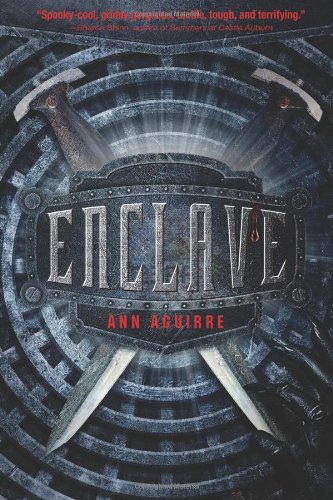
Review: "Enclave" by Ann Aguirre


"Enclave"

Author: Ann Aguirre

Publisher: Feiwel and Friends

Pages: 259

Summary (taken from GoodReads): In Deuce’s world, people earn the right to a name only if they survive their first fifteen years. By that point, each unnamed ‘brat’ has trained into one of three groups–Breeders, Builders, or Hunters, identifiable by the number of scars they bear on their arms. Deuce has wanted to be a Huntress for as long as she can remember.

As a Huntress, her purpose is clear—to brave the dangerous tunnels outside the enclave and bring back meat to feed the group while evading ferocious monsters known as Freaks. She’s worked toward this goal her whole life, and nothing’s going to stop her, not even a beautiful, brooding Hunter named Fade. When the mysterious boy becomes her partner, Deuce’s troubles are just beginning.

Down below, deviation from the rules is punished swiftly and harshly, and Fade doesn’t like following orders. At first Deuce thinks he’s crazy, but as death stalks their sanctuary, and it becomes clear the elders don’t always know best, Deuce wonders if Fade might be telling the truth. Her partner confuses her; she’s never known a boy like him before, as prone to touching her gently as using his knives with feral grace.

As Deuce’s perception shifts, so does the balance in the constant battle for survival. The mindless Freaks, once considered a threat only due to their sheer numbers, show signs of cunning and strategy… but the elders refuse to heed any warnings. Despite imminent disaster, the enclave puts their faith in strictures and sacrifice instead. No matter how she tries, Deuce cannot stem the dark tide that carries her far from the only world she’s ever known.

Cover impressions: After receiving a copy of this book from GoodReads friend Lucy, I was immediately drawn to the Publisher’s Weekly quote declaring the book to be “for fans of The Hunger Games”. Such comparison quotes, while attention grabbing and common practice amongst publishers, immediately set up a certain level of expectations, even in the most cynical of readers. While I haven’t actually finished reading The Hunger Games yet (I’ll get round to it eventually, I swear!), I began this book with the same expectations I have for every dystopian novel – strong world-building and a real threat & sense of danger.

There are books that make me consider discarding use of the flawed star rating system for reviews. Sometimes it’s close to impossible to summarise the qualities of a book into a simple rating out of 5, 10 or however one chooses to do so. A book can be a relatively enjoyable and competently written piece of work that would otherwise deserve a solid rating, but a certain element, event, etc, can bring its rating tumbling down. This happened to me with Sarah Beth Durst’s “Ice” and it happened with “Enclave”. But before I get to why I cannot give this book anything higher than one star, I shall discuss other elements of the book that succeed and fail.

I’m sure you’re all sick of me going on and on about this but the foundations of a strong dystopian novel lie in its world-building. Unusual or disturbing events can’t just happen for shock value. They need to be rooted in the origins of the society, grounded in reason, meaning the reason of this world. This fundamental lack of reason within the world-building in “Enclave” left more than a few questions unanswered. The underground society Deuce lives in does not name its young, known as brats, until a specific age, which is never mentioned. Why? There doesn’t seem to be any specific reasoning behind this rule and seems too impractical to fit in with a world that works to prove itself as fundamentally practical. There are hints of a cult-like mentality to the ruling class of the world but it’s barely touched upon and leaves us with half-built reasoning. Children are sanctioned into one of three groups – warriors, builders or breeders – yet the reasons for specific grouping once again seem at odds with the necessary practicality & needs of this society. One breeder, Deuce’s friend, is seen as ideal for his calling because he is handsome, but I failed to see why this would be a relevant quality in a world where death & disease are rampant. Other extremely questions go unanswered – how does this enclave have clean water after generations underground? How does Deuce go from a lifetime underground to full on exposure to sunlight and only get slightly burned with no damage to her eyesight?

The writing itself is adequate, if simple, and has well-paced action scenes, although the overall pacing is erratic. Certain scenes are evident padding and clumsy plotting, which coupled with several under-developed plot points proves to be somewhat frustrating. No character other than the heroine is given adequate time to develop beyond basic tropes, although I did warm to Deuce somewhat throughout the first half of the novel. However, it is one particular character and how others react to him that soured things for me.

A little more than midway through the novel, Deuce is kidnapped by a gang who make their intentions towards her clear – they intend to use her for breeding purposes, forcefully if need be. Later we are introduced to Tegan, a fellow kidnapped woman who has been raped repeatedly and given birth to stillborn children. After altercations with the story’s main monsters, the Freaks, the head of the gang, Stalker (yes, really), decides he will go along with Deuce, Tegan and main love interest Fade in order to have a better chance of surviving. Fade and Deuce agree to this, despite Tegan’s protests that she does not feel safe around the leader of the gang of rapists who repeatedly violated her for years. Later on, Stalker pushes Deuce against a tree and kisses her.

Deuce reciprocates.

I’ve made my thoughts clear on the ‘bad boy’ trope in YA; I don’t like it. I understand the fantasy behind being the one girl who changes the rebel but ultimately I think it’s a problematic trope that is all too often used as an excuse to have the love interest treat the heroine like dirt, often being rough with her and belittling her.

Patch from “Hush Hush” held his love interest against a bed and talked about how much he wanted to kill her after stalking her, harassing her and generally making her feel uncomfortable and unsafe.

Stalker is the leader of a gang of rapists. It is hinted at in the book that he has raped women before. It is also implied that he may have raped Deuce during her kidnapped period.

He is presented as a potential love interest to Deuce.

The aim of a good dystopian novel is to create a sense of dread. I have seen rape mentioned in other dystopian novels and within the constraints of this world where humans die young and need to reproduce quickly, it makes sense that a patriarchy dominated society would view women in such a manner. However, I have never seen rape used so casually and tossed aside so simply by a character and an author in a YA novel. There is a cruel lack of empathy for Tegan in “Enclave”. Even within the constraints of the novel’s world, one ruled by social Darwinism, to force Tegan to interact daily with the man who stood by & let her be raped repeatedly, possibly ordering the rapes himself or even engaging in the horrific act himself, is baffling at best and disgusting at worst. As the novel progresses, Tegan grows (lazily from a characterisation point-of-view) from a victim into a ‘strong’ young woman who can fight back, but all I could think about was how her rape was used in such a cavalier fashion. Deuce, who started off with such potential (even if she did fall into the typical romantic plot tropes with mysterious bad boy Fade), does not question Stalker or his past actions. Instead, she lays some of the blame on Tegan. The dismissive attitude she has towards a victim of multiple rapes is abhorrent. At one point she asks herself how Tegan could have been so weak as to allow the events to happen. Deuce’s general attitude is that life is tough, and if she can suck it up and get on with her life, so can Tegan. Even within the context of the novel, this felt wrong on every level. Deuce, who had previously shown moments of true empathy, becomes someone who sympathises more with a rapist than the victim of rape. I shouldn’t even have to explain why this made me sick. And that’s why I can’t give this book anything more than one star.

I don’t expect every book in the world to be a beacon of social justice and feminism; that would be stupid. What I do expect is for a book to follow the rules it sets for itself. “Enclave” fails on this thanks to its inconsistent and confusing choices in its world-building, which seem to exist more for shock value than any real sense of reason. It’s a mediocre novel that becomes disgusting when something as serious, life changing and horrific as rape is used so clumsily. Rape is NEVER the woman’s fault. She’s never ‘asking for it’ and she’s certainly never deserving of pity or scorn because she was unable to fight back. Bad boys are problematic enough, but making a rapist not only a sympathetic character, one who receives a degree of sympathy from the heroine not rewarded to the victim, but a potential love interest is flat-out inexcusable.

1/5.

  • Digg
  • Del.icio.us
  • StumbleUpon
  • Reddit
  • RSS

Review - "Crescendo" by Becca Fitzpatrick.

“Crescendo”

Author: Becca Fitzpatrick.

Publisher: Simon and Schuster.

Pages: 427.

Synopsis (taken from GoodReads): Nora Grey's life is still far from perfect. Surviving an attempt on her life wasn't pleasant, but at least she got a guardian angel out of it: a mysterious, magnetic, gorgeous guardian angel. But, despite his role in her life, Patch has been acting anything but angelic. He's more elusive than ever and even worse, he's started spending time with Nora's arch-enemy, Marcie Millar.

Nora would have hardly noticed Scott Parnell, an old family friend who has moved back to town, if Path hadn’t been acting so distant. Even with Scott's totally infuriating attitude Nora finds herself drawn to him - despite her lingering feeling that he's hiding something.

Haunted by images of her murdered father, and questioning whether her nephilim bloodline has anything to do with his death, Nora puts herself increasingly in dangerous situations as she desperately searches for answers. But maybe some things are better left buried, because the truth could destroy everything - and everyone - she trusts.

Cover impressions: So... I gave in. A little bit of history: my recap/review/exasperated rant of maximum strength of Becca Fitzpatrick’s debut, “Hush, Hush”, the 3rd book in the original Sparkle Project, is probably the thing I’m most well known for. In short, I hated the book, primarily because I just couldn’t believe that the author was writing a so-called love story where Patch, the designated male love interest’s abhorrent actions, including stalking, sexual harassment, borderline abuse and threats of murder, were considered okay because he was a sexy bad boy. There is a scene in “Hush, Hush” where Patch holds Nora down on a bed and tells her how he has planned to kill her... then he kisses her. And this is all okay. I hated this book so much I threw it against a wall twice and it’s become the marker of comparison for every YA book I read in terms of bad romance. I wasn’t going to review “Crescendo” at first. After all, what would be the point? My view of “Hush, Hush” was never going to change, even if its sequel ended up being the YA equivalent of “The Dark Knight.” But the honest truth is this; I wanted to see if things got better. Or worse. Fitzpatrick has gone on the record as saying it took her 5 years to write her first book and she had no intention of writing a sequel until her agent got her a 2 book deal (she now has a three book deal with “Silence” due out this Autumn) so I wanted to see how everything changed. To be honest, I wanted to see what happened next with Patch and Nora. How exactly does one write a romance that’s so obviously dangerous and messed up and pretend everything’s okay? I saw a copy of the book in my local library and decided just to go for it.

I need to state this up front, since book bloggers are getting a bad name lately and the atmosphere in YA blogging has become really tense lately; I don’t go into books looking to write bad reviews. Even with the original Sparkle Project, my intention was to analyse a genre trend from the point of view of a feminist YA nerd and spot its problems and perils. Yes, I did it in an incredibly snarky manner which has led some people to disregard my reviews, but my intention was and still is to give the genre the analysis it deserves. It’s not a lesser, inferior mode of literature that deserves a lower opinion from readers. I didn’t go into “Crescendo” wanting to hate it. Honestly, I really wanted this to be better because I want to believe so much that one day we can stop bullshitting around and messing up perceptions of romance and relationships for teenagers. But the honest truth is that “Crescendo” is a huge disappointment, depressingly so.

The thing that worried me from the offset in this book, one chapter in (ignoring the prologue that clumsily sets up the intrigue but really gives everything away), is the establishment of Marcie, a flat, incidental character from the first book, as Nora’s ‘nemesis.’ She is immediately set up as the polar opposite of Nora based on her promiscuous dress sense. A former friend of Nora’s, she now apparently loathes her solely because “you were born.” She doesn’t get any deeper level of character development throughout the story. She’s the bad girl, the bully, the slut.

The slut. And she’s shamed at every possible moment for it. Nora, supposedly the good girl and polar opposite of Nora, frequently makes bad handed references to Marcie being a slut or a whore or any variation on that term and this is reason enough to hate her. Her sexuality is used as a reason to dislike Marcie (although, conveniently enough for Nora, it’s okay for her to be sexually suggestive as well as Patch, because bad boys equal sexy while bad girls equal sluts, and Patch and Nora never actually have sex so they’re pure and worthy to mock Marcie). Being sexually active in any sort of way isn’t just bad, it makes you a bad person. It’s also Marcie who’s constantly at fault in these issues, never Nora or Patch. It’s Marcie that steals Patch from Nora, even though Nora broke up with him! Nora’s never the bad person, even when she admits to doing bad things to Marcie (the instance given – Nora deliberately picking an unflattering photo of Marcie for the school magazine – while rather petty, is important to note because Nora is never chastised for these sort of incidents but Marcie constantly is. She also steals Marcie’s diary for further slut-shaming opportunities.)

Marcie isn’t the only one that suffers from weak characterisation. Vee, supposedly Nora’s best friend, is here once again to be fat and a form of comic relief, apparently her only defining traits. Scott, the jerk that isn’t Patch, embodies all of the traits Patch has but because he isn’t the designated love interest, he’s not as sexy (but still aesthetically pleasing of course). Nora and Patch don’t evolve at all. In fact, they become even more annoying. Nora, when she isn’t slut shaming to the maximum, has devolved into vaguely psychotic stalker girlfriend territory and Patch is still an utter creep. The majority of their conversations are made up of supposedly charming innuendo which, if coming out of the mouth of someone who didn’t look like a male model, would be sexual harassment, and arguments over petty nothingness in an attempt to get some plot into this story-less mess. Almost everyone in this story knows that Patch is bad news and often tell Nora this, yet common sense just doesn’t exist to her (although her mother seems adamant on setting her up with an equally big douche-bag with a criminal record who seems to get the free pass Patch doesn’t because he was an old childhood friend of Nora’s.)

She also seems to be obsessively in lust with Patch rather than love. It’s been established that he cannot feel anything for her on a physical level (so I’m guessing his constant creepy sex talk is some form of over-compensation) but he admits to loving her emotionally, but she says, when breaking up with him (probably her smartest moment), “When I kiss my boyfriend, I want to know he feels it.” I tried to find 5 things that Nora and Patch had in common, something for them to discuss as a couple, hobbies to share and the like, and couldn’t find a thing (school activities do not count.) Their obsessive ‘love’ is their only defining trait, although Nora also seems to be make a beeline into the field of amateur stalking and kleptomania. The relationship seems to be following the now standard pattern for YA – book one = establishment of true but oh so forbidden love and book two = circumstances bring love to a temporary end. The male figures are constantly asserting their dominance like it’s a peacock strutting competition; there’s one worrying scene where Scott grabs Nora and she screams for help yet nobody does. Someone even laughs at her. Between this and the horrid biology scene in the first novel, I can’t help but worry about the attitudes towards women in these books, especially when it’s fair to use the word ‘attack.’ The story is so clearly following a derivative pattern that you can practically seen the join-the-dots. While there is less emphasis on the love story – phew – the mystery that makes up the majority of the plot plods along with no real finesse or surprises, with characters doing and saying stupid stuff solely for plot advancement. There are a few interesting moments here and there but it’s all handled so clumsily with inconsistent plotting that it’s difficult to care, a hefty task when this novel is also populated with a cast that varies from the forgettable to the lazily characterized to the downright awful.

It all wraps up with a big cliff hanger that has potential but having been burned so much from this sequel, even my masochistically curious side isn’t very interested in seeing what happens next. “Crescendo” is not a good book in any sense of the word. It suffers from the same problems “Hush, Hush” did – poor plotting and pacing, weak characterisation, lazy mythos, derivative and predictable paranormal romance traits – as well as some elements I just can’t ignore. I hate slut-shaming, everyone should hate it. It’s a false stereotype, it does nothing but label and demeans women and it reinforces old assumptions about women and sex that we just do not need in our world, especially in our teenage world. Marcie Millar is characterised solely on her sexuality and how bad it makes her. She likes sex because she’s bad and she’s bad because she likes sex. It’s unfair, it’s reinforcing stereotypes and it’s just plain lazy characterisation. On top of all this we have Nora Grey who has quickly become one of the most unlikeable, irrational, paranoid, hysterical and downright stupid characters in young adult fiction. I’m pretty offended on behalf of teenage girls everywhere that are supposed to relate to her. Good old Patch is out of the scene for a lot of this book but he remains a jerk. Nice to know some things don’t change. I worried about the reinforcement of rape culture in “Hush, Hush” and now I worry about the perpetuation of slut-shaming and the virgin-whore dichotomy in “Crescendo.” I shudder to think what “Silence” will bring us. Overall, yet again I remain perplexed as to how these books have become as popular as they have. We have to do better than filling books for teenage girls full of the same old falsehood that short skirts and an interest in sex equals a spoiled moral code. Surely we’re better than this?

1/5.

  • Digg
  • Del.icio.us
  • StumbleUpon
  • Reddit
  • RSS

What makes you say no?

Thanks for all the great comments my last couple of posts got pertaining to Bitch-gate and the discussion of feminist YA. As always feel free to continue commenting, I am so glad that the dust is dying down and we can actually have a proper talk on the topic. But the world continues to turn and there are always other fish to fry.

It's no secret that as well as being a book nerd I am a film buff. So when I saw that there was going to be an adaptation of the play God of Carnage starring one of my favourite actresses Kate Winslet, I was very excited, a feeling that only grew when I noticed Christoph Waltz, John C. Reilly and Jodie Foster had also signed on. But my happiness was short lived when I noticed 4 words that meant I would never allow myself to pay money to see this film:

Directed by Roman Polanski.

I have the same basic attitude to Polanski as I do to Orson Scott Card; I don't want to give any of my money to either of them. In both instances, I can acknowledge their talent and influence but both are cases where their personal beliefs and actions have become too much for me to put aside and ignore in favour of judging their work based solely on its merits. I know Ender's Game is a good book and I know he's a good writer but I cannot review one of his books because all I can see and think about is his abhorrent views on homosexuality and how much money he donated to causes supporting Proposition 8 (check the comments in The Book Smugglers' review of his latest book for such discussion). With Polanski all I can think about is a man getting away with drugging and raping a 13 year old (and I continue to shudder at so many people in Hollywood whom I respect supporting him despite this disgusting thing he did.)

Sometimes I can separate the author and their work very easily - I'm a huge Disney fan even though Uncle Walt himself was a racist anti-Semitic sexist jerk who ratted out innocent people during the McCarthy years - but there are instances where it's impossible for me to do so. In the case of Scott Card it's because I can't allow myself to give the man money ergo indirectly donating to causes I oppose with every fibre of my being. Even though, I've been told, his work doesn't contain any instances of him expressing such views, it's pretty much impossible for me to separate the man and his work, especially since he chooses to put himself out there as a vocal anti-gay rights person.

This sort of stuff extends to other media for me - I avoid anything involving Mel Gibson, Charlie Sheen, Chris Brown, etc. It may be a bit ridiculous to some, especially since me trying to avoid every film or piece of entertainment involving the countless people in the film/TV industry who signed that petition supporting Polanski would mean I couldn't watch any films ever (I did try for a couple of weeks), but it's what works for me. But it does make me something of a hypocrite since I enjoy the works of people whom I often have disagreements with or oppose on certain views - I love Stephen Moffat's work on Sherlock and Doctor Who even though his frequent misogynism bugs the hell out of me. I don't know what my mini protest is ever going to do with this sort of stuff - OSC's not going to stop being a bigot just because I refuse to buy his works, same for Brandon Sanderson and James Ellroy - but as I said, it works for me and it's no skin off my back never getting to read another Ender novel.

Where is the line for you? Can you separate the author and the work easier than I can?

  • Digg
  • Del.icio.us
  • StumbleUpon
  • Reddit
  • RSS