Followers

Powered by Blogger.
RSS
One highly opinionated feminist YA nerd's twisted, snarky and informative journey through the genre's perils, pitfalls and sparkles.
Showing posts with label 3 stars. Show all posts

Review: "Past Perfect" by Leila Sales.

“Past Perfect”

Author: Leila Sales.

Publisher: Simon Pulse.

Pages: 322

Synopsis (taken from GoodReads): All Chelsea wants to do this summer is hang out with her best friend, hone her talents as an ice cream connoisseur, and finally get over Ezra, the boy who broke her heart. But when Chelsea shows up for her summer job at Essex Historical Colonial Village (yes, really), it turns out Ezra’s working there too. Which makes moving on and forgetting Ezra a lot more complicated… even when Chelsea starts falling for someone new.

Maybe Chelsea should have known better than to think that a historical reenactment village could help her escape her past. But with Ezra all too present, and her new crush seeming all too off limits, all Chelsea knows is that she’s got a lot to figure out about love. Because those who don’t learn from the past are doomed to repeat it…

Cover impressions: Sometimes there is nothing that will satisfy a reader such as myself like a good piece of sweet fluff. That is not in any way meant as an insult towards “Past Perfect” and other such books, there’s no such room for genre snobbery in my eyes. While genre fiction such as horror, romance and the romantic comedy, which is how I would classify this book, are the first to be mocked or derided, it’s worth remembering that it’s pretty damn hard to write a convincing and entertaining piece of genre fiction. Writing a romantic comedy that can use familiar tropes of the genre and remain charming and entertaining is a tough task, and I’m pleased to say that, for the most part, Leila Sales pulls it off.

The unconventional setting – a colonial village re-enactment centre - and set-up for the novel creates countless opportunities for entertainment and mayhem. Some of the funniest moments of the book come from the over-the-top and gleefully ridiculous war plans between the colonial re-enactment workers and the civil war re-enactors right across the road. It’s incredibly petty and immature but there’s something undeniably funny about Churchill war speech parodies and battle strategies that revolve around historical anachronisms. This element of the book was definitely my favourite part and I only wish more time had been dedicated to it rather than Chelsea’s love life.

While I appreciated that Sales spent some time deconstructing the rose-tinted image of her ex boyfriend that Chelsea had built up for herself, so much time is spent with Chelsea in moping mode that it became very tiresome. I think one’s mileage may vary for such scenes and will depend on the reader’s emotions towards Chelsea. I did not find her to be a particularly brilliant protagonist. She had her moments – I enjoyed her ice-cream taste testing – and I greatly appreciated her close relationship with her quirky parents and group of friends, but said moping grated on me. She also makes a couple of plot driving decisions that made me lose all sympathy for her. If I was to pick a character in the novel to follow, it would be Tawny, the general of the colonial workers in the war.

There was one element of the romance plotline that really got to me. This small rant is partly inspired by this book but is also something I’ve had on my mind for a while so please take this with a pinch of salt when considering reading this book for yourself. Dan, the primary love interest of the novel, is set up in a forbidden love style element (a “Romeo & Juliet” parallel is actually mentioned by Chelsea, but since the war between both sides spends most of its time in war parody mode, don’t take that comparison too seriously) so of course there needs to be a degree of animosity between the pair, coupled with that trademark jerk charm so common with male love interests. I’ve become rather fed up with books, mainly YA, where the male love interest is characterised by being charming when he’s really a smug know-it-all that borders on insulting. Chelsea’s often not very likeable but generally I find it difficult to believe that every teenage girl is charmed and seduced by this sort of behaviour. The fact that such behaviour is often the only defining characteristic of many male love interests is even more infuriating for me. Luckily, Dan is given more depth than this but it does make the romance between him and Chelsea harder to believe considering her own decisions.

The key to this book lies in its charm. Sales writes a well paced and often very funny book with witty observations, an interesting supporting cast to prop up a less than perfect protagonist, and a whole assortment of pranks, jokes and completely ridiculous war parodies with just a pinch of history. “Past Perfect” won’t be considered groundbreaking by any standards, and the romance angle will be read differently by different readers depending on one’s opinion of such elements, but it’s a quick read with bagfuls of charm you could have a lot of fun reading.

3/5.

“Past Perfect” will be released in USA on October 4th. I received my arc from Simon & Schuster’s Galley Grab program.

  • Digg
  • Del.icio.us
  • StumbleUpon
  • Reddit
  • RSS

Review: "Wrapped" by Jennifer Bradbury.

“Wrapped”

Author: Jennifer Bradbury.

Publisher: Atheneum.

Pages: 324.

Synopsis (taken from GoodReads): Agnes Wilkins is standing in front of an Egyptian mummy, about to make the first cut into the wrappings, about to unlock ancient (and not-so-ancient) history.

Maybe you think this girl is wearing a pith helmet with antique dust swirling around her. Maybe you think she is a young Egyptologist who has arrived in Cairo on camelback. Maybe she would like to think that too. Agnes Wilkins dreams of adventures that reach beyond the garden walls, but reality for a seventeen-year-old debutante in 1815 London does not allow for camels—or dust, even. No, Agnes can only see a mummy when she is wearing a new silk gown and standing on the verdant lawns of Lord Showalter’s estate, with chaperones fussing about and strolling sitar players straining to create an exotic “atmosphere” for the first party of the season. An unwrapping.

This is the start of it all, Agnes’s debut season, the pretty girl parade that offers only ever-shrinking options: home, husband, and high society. It’s also the start of something else, because the mummy Agnes unwraps isn’t just a mummy. It’s a host for a secret that could unravel a new destiny—unleashing mystery, an international intrigue, and possibly a curse in the bargain. Get wrapped up in the adventure . . . but keep your wits about you, dear Agnes.

When I was little, I went through a serious phase of loving all things ancient Egypt, which grew into a Victorian detective novel love when I hit my teens. This book combines two of my greatest nostalgic loves so of course I had to pick it up! Overall, I was pleased with “Wrapped” and enjoyed it, but I didn’t love it.

The greatest strength of “Wrapped” lies in Agnes, its witty, independent and imaginative heroine. She falls into the typical heroine trope traps but is executed with a certain flair I found rather charming, and also manages to have several moments of surprising complexity I didn’t expect in what is essentially a light-hearted romp. For a novel with this sort of story, I think you need a heroine like Agnes, and she was what kept me reading throughout the occasional drops in pace. There was one thing about her that frustrated me and that was her frequent references to A Lady, the pen-name for Jane Austen. Agnes is a smart girl with a love of books, which I appreciated and related to, but her constant references to Austen began to grate on me very quickly. The other characters didn’t quite have the same impact on me and felt very stock, but they got the job done.

There really isn’t much for me to say about “Wrapped” because it’s a simple, light-hearted romp that one shouldn’t take too seriously. There dialogue is often anachronistic, some of the history doesn’t quite add up and the mystery at the centre of the story is pretty predictable, but it’s all very readable, often highly enjoyable and a good way to waste a few hours, which is in no way a criticism. I had fun reading about the Egyptian myths and rituals, It’s not going to break any boundaries or set a standard in historical YA, but it is a good fluffy read. I think younger YA readers may enjoy it more than I did.

3/5.

I received my e-ARC from Simon and Schuster's Galley Grab programme.

  • Digg
  • Del.icio.us
  • StumbleUpon
  • Reddit
  • RSS

Review: "Ultraviolet" by R.J. Anderson

“Ultraviolet”

Author: R.J. Anderson.

Publisher: Orchard Books.

Pages: 384.

Synopsis (taken from GoodReads): Once upon a time there was a girl who was special.

This is not her story.

Unless you count the part where I killed her.


Sixteen-year-old Alison has been sectioned in a mental institute for teens, having murdered the most perfect and popular girl at school. But the case is a mystery: no body has been found, and Alison's condition is proving difficult to diagnose. Alison herself can't explain what happened: one minute she was fighting with Tori -- the next she disintegrated. Into nothing. But that's impossible. Right?

Cover impressions: I am a sucker for the dark side of literature. Growing up, I went through a massive phase of reading books about crime, serial killers and down-trodden detectives looking to solve the case, so seeing the synopsis of this book on NetGalley made it an instant must read for me. The book was surprising on many levels and it’s a real genre bender, not quite the straight forward dark thriller I thought it was going to be, but did it work?

Some of it worked rather well. It becomes evident very early on that Alison has the condition synaesthesia, where one’s senses cross over and interact in interesting ways. For Ali, this involves different numbers and letters having distinctive tastes and colours as well as some surprising experiences that occur throughout the book. I really enjoyed the way this was incorporated into the story and it provided a fascinating view of the world from a truly unique perspective. Anderson’s prose is particularly strong during these points and also rather beautiful. The more lyrical moments of prose don’t always work within the context of the story though; sometimes it felt a little jarring. It was always enjoyable to read but I questioned whether it was the right stylistic choice at these moments in time. While Ali’s narration is fascinating, it also means we sometimes don’t get a fully realised view of the world she lives in. This isn’t a problem to begin with – Anderson effectively creates a sense of foreboding and intrigue as Ali discovers what has happened – but then it goes a little off the rails, mainly because of Ali.

I didn’t mind Ali as a character. I understood her fear and sympathised with it for most of the book, plus her narration, as I said, was very lyrical and interesting at times. However, her decision making process left me feeling a little frustrated. I’m not a fan of characters avoiding the obvious for the sake of plot development. Sometimes it felt like Ali wasn’t allowed to progress because the author had decided it wasn’t time for that yet. While I understood Ali’s difficulties and worries over making certain choices, it still didn’t feel natural. I also felt like we didn’t get a lot of characterisation for the supporting players, especially Ali’s fellow patients and the mysterious Dr Faraday.

There are two small, very specific things in the book that I really want to touch upon, and to do this there may be slight spoilers.

Unfortunately, the book casually drops in one of my biggest irritants in YA fiction – the casual gay joke. One of Ali’s fellow patients, who is bipolar, makes several references to Dr Faraday being gay (he isn’t gay but the boy, whose name I have unfortunately forgotten, keeps saying he is out of jealousy, I think) and no-one chastises him for it. Ali silently expresses disapproval but nobody points out how stupid and insulting it is to casually use homosexuality as a negative marker of someone. The boy was frequently punished for saying stupid thing so why not this? It’s a small thing, I know, but I’ve seen it used so frequently in fiction without any character, or even the omniscient narration, taking the time to say it’s wrong, and it bugs me because we’ve still got this society that uses ‘That’s gay’ as some ultimate insult. Homosexuality is still somehow the acceptable insult these days.

The other problematic element I had also involves this young man forcing himself on Ali. She pushes him back, screams and makes it pretty clear that she doesn’t want this and when the boy has the audacity to be insulted by this, she say sorry. Even though she mentions in her narration that she really isn’t sorry, she still says it. She didn’t have to say it! She wasn’t the one at fault here; mental illness or not, the woman, or man, shouldn’t apologise for having someone force his or herself upon her/him! Later on, the issue is dealt with and the boy is punished but this little scene still nagged at me so I had to address it.

Overall, I like a lot of thing about “Ultraviolet.” The incorporation of synaesthesia was fascinating and well handled, providing an often beautiful and unique narration, and the set-up is intriguing for the most part. I admire Anderson for taking the book out of the comfort zone and not sticking to the well worn and seductively easy routes YA has so often been taking lately. It doesn’t always work but I was never bored by what I read, even if some of it was a little sketchily developed. The strong elements that kept me reading were let down by some weaker moments of plotting and characterisation. I’m really not sure how to rate this book. It’s either a 2.5 or a 3 out of 5. There’s definitely a lot to enjoy in the book and it’s refreshing to see something unique in the genre right now, but for all its strengths it could have definitely been stronger.

2.5 or 3/5 (apologies for my indecisiveness, I genuinely spent ages trying to pick one and couldn’t!)

“Ultraviolet” will be available to read in USA on 2nd June 2011. I received my ARC from NetGalley.com.

  • Digg
  • Del.icio.us
  • StumbleUpon
  • Reddit
  • RSS

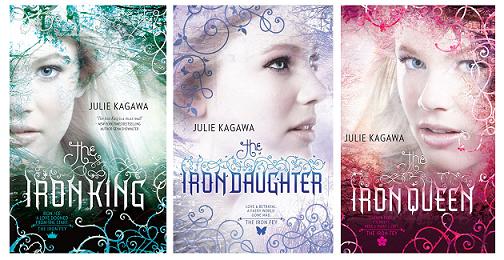
Review - "The Iron Fey Trilogy" by Julie Kagawa.


“The Iron Fey Trilogy”

Author: Julie Kagawa.

Publisher: Harlequin Teen.

Books: The Iron King, The Iron Princess and The Iron Queen.

Synopsis for The Iron King (taken from GoodReads): Meghan Chase has a secret destiny—one she could never have imagined…

Something has always felt slightly off in Meghan's life, ever since her father disappeared before her eyes when she was six. She has never quite fit in at school… or at home. When a dark stranger begins watching her from afar, and her prankster best friend becomes strangely protective of her, Meghan senses that everything she's known is about to change. But she could never have guessed the truth—that she is the daughter of a mythical faery king and is a pawn in a deadly war. Now Meghan will learn just how far she'll go to save someone she cares about, to stop a mysterious evil no faery creature dare face…and to find love with a young prince who might rather see her dead than let her touch his icy heart.

Cover impressions: When I was working in Waterstones (I miss that job so much) I noticed an article in the Publishers monthly magazine we were sent about Harlequin moving into the YA market and this was one of the books they were advertising very heavily, along with Rachel K. Vincent’s Soul Screamers series. I’m not really a fairy fan but the Midsummer Night’s Dream comparisons and the fact that I got an e-ARC of the 3rd book in the trilogy (from NetGalley) convinced me to pick the series up.

The series, and the elements within, are sort of a mixed bag. The characters are archetypal of the paranormal genre but there are a few gems within, the set up is very familiar but often executed with flair and creativity, the love story is deathly dull but the world building and mythology is fascinating. There’s a lot to cover and I’m going to do it spoiler free.

Meghan, our heroine, is your pretty standard paranormal YA heroine; she’s an outcast who thinks she’s plain but is actually gorgeous, she’s got family troubles, is supposed to be smart but often makes incredibly stupid decisions and exhibits bravery when necessary. She’s not the worst YA heroine I’ve come across but there was nothing particularly distinguishable about her either. Ash, the main love interest, was also equal levels of dull and the same old dark, mysterious and faintly jerky sexy hero we’ve become oh so accustomed to in the genre. Puck is more promising but the highly predictable love triangle set up does neuter him somewhat. In general, the love element just dragged everything down. I don’t know how much of this has to do with me just being so worn down by love stories in YA, especially three pronged ones, but it felt very samey and poorly developed. As always, things go from cold indifference to light contempt to undying love with no real exchanges beyond the stock formula. Part of its failing lies in the fact that our young lovers are just so damn boring. The real gems are in the supporting characters and the villains, even if the first book’s baddie did have me thinking a lot about Jareth from Labyrinth (which is never a bad thing!)

Kagawa has picked her inspirations from the best selection possible – you’ve got traditional fairy lore, Shakespearean comedy and some modern day stuff like Jim Henson’s Labyrinth, one of my childhood staples. The book really shines with its mythos – the traditional clashing with the modern, knowing full well that they can’t survive together, and the Iron Fey concept is genuinely great stuff. If you’re familiar with other fairy YA – Melissa Marr, Holly Black, etc – it may feel a little too familiar to you but it’s still interesting stuff. While the general set up of the trilogy feels very familiar, Kagawa handles it in an interesting way and keeps the plotting fast and interesting. The vast world is populated with a mish mash of creatures and characters that stop things from getting too dull. It’s a very readable series, even if it never fully steps into greatness.

And that’s how I can sum up this series without spoiling anything. Each book is good and very readable, with some great elements in amongst the overly familiar, and I did enjoy the books despite the view my review may present to you, but the books never ascend to greatness. They’re fun, light reads that won’t take up too much of your time and if you’re a fan of this sort of mythology, it’s definitely worth a read. I’m just finding it difficult to say anything more beyond this. Each book flows well and the series is relatively tightly plotted with some action and violence to keep you going through the plodding, deathly dull romance, and the supporting cast make up for the dishwater-like heroes, but it’s all fluffy, mindless fun.

The Iron King: 3.5/5.

The Iron Daughter: 3/5.

The Iron Queen: 3/5.

Coming next on The Sparkle Project: So... there's a copy of Becca Fitzpatrick's "Crescendo" in my local library... should I?

  • Digg
  • Del.icio.us
  • StumbleUpon
  • Reddit
  • RSS

Review: "Shade" by Jeri Smith-Ready.


“Shade”

Author: Jeri Smith-Ready.

Publisher: Simon and Schuster.

Pages: 309.

Summary (taken from GoodReads): Best. Birthday. Ever. At least, it was supposed to be. With Logan's band playing a critical gig and Aura's plans for an intimate after-party, Aura knows it will be the most memorable night of her boyfriend's life. She never thought it would be his last. Logan's sudden death leaves Aura devastated. He's gone. Well, sort of.

Like everyone born after the Shift, Aura can see and hear ghosts. This mysterious ability has always been annoying, and Aura had wanted
nothing more than to figure out why the Shift happened so she can undo it. But not with Logan's violet-hued spirit still hanging around. Because dead Logan is almost as real as ever. Almost. It doesn't help that Aura's new friend Zachary
is so understanding--and so very alive. His support means more to Aura than she cares to admit. As Aura's relationships with the dead and the living grow ever complicated, so do her feelings for Logan and Zachary. Each holds a piece of Aura's heart...and clues to the secret of the Shift.

Cover impressions: This cover is horrible. It looks cheap and lazy and not particularly exciting. That’s a real shame because believe it or not, I actually quite enjoyed this book and think Simon and Schuster really dropped the ball by not giving this book a more appealing cover like some of their recent YA output *evil stare towards Hush Hush*. I received my copy from the publisher thanks to a competition by the Book Smugglers. It’s the first time I’ve ever won a book as well. I haven’t seen a lot of interesting ghost centred stories in the YA genre right now so I was definitely intrigued by this book, terrible cover aside (the US one is much nicer apparently.)

Thanks to my recent reading choices of deadly masochistic tendencies, I’ve developed something of a paranoid fear over paranormal YA. I’m much more wary about dipping my toes into the pool to sample what’s out there for fear of head-desk inducing moments. But I have to say I found “Shade” to be very enjoyable. The basic premise – that everybody born after a specific date has the ability to see and communicate with ghosts – set up an interesting universe with the dynamics seemingly tilted favourably towards the younger generation. Since ghosts have become part of society in a way, it’s up to all ‘post-shifters’ to help out and Aura, our protagonist, who’s auntie and guardian Gina is a lawyer prosecuting in the name of ghost related cases, is particularly heavily involved in such situations. Smith-Ready did a pretty good job showing the dynamics between pre and post-shifters, showing the frustrations and problems encountered by both.

I won’t lie, I did a little air-punch when I realised how much I actually liked Aura as a character and all that credit goes to the author, who did a great job keeping her as a normal teenager and not a patron of the good ship Mary Sue. Yes, she has this amazing ability but so does everyone else under sixteen. She has her mopey moments but you as the reader actually understand why she feels the way she does. She’s hurt, confused and reeling with emotions much bigger than anyone her age is supposed to deal with. She’s grown up in a world where the seemingly impossible is the norm and while she is frustrated with having the dead surround her begging for her help, she understands the toughness of this situation for the others less fortunate than her. Even when the story falls into love triangle territory – probably one of my least favourite things in YA because it’s seldom executed well – I still sympathised with and understood Aura’s choices. And, here’s the kicker, she has a fantastic and responsible attitude towards sex! Okay, the derogatory whore terms are mentioned once or twice in passing which made me flinch but otherwise Aura is not ashamed of her desires and needs. For the more fragile of nature (or whatever you want to call it) there is a brief scene where Aura is on auto-pilot but it didn’t bother me at all. She’s a teenager; of course she’s doing that! Most importantly, she’s a believable teenage girl. She also has a hilarious line slyly lamp-shading a certain series about sparkly things that I daren’t speak of in public.

It’s such a shame that the two objects of her love and confusion weren’t as interesting as Aura herself. On the plus side they’re not deathly dull YA romance stereotypes. Logan is flighty, irresponsible and a little naive but he genuinely loves Aura and regrets his mistakes. While Zachary, the sarcastic Scottish exchange student (hell yeah, patriotism rules!), is probably a much more archetypal character – the witty, slightly smug but gorgeous exotic figure with eyes for only one – he has some interesting traits. Smith-Ready also managed to keep the Scottish-isms to a low, keeping the slang natural and not too distracting. While I still hope that one day love triangles will become as outdated a literary fad as sparkly creatures, in this book I didn’t mind it and it grabbed my interest long enough.

The pacing suffers a bit in the middle and the plotting wavers in places since most of the really exciting stuff doesn’t come until towards the end, and the last few pages definitely feel a little rushed. The story itself feels a little too familiar, even with the interesting mythos in place. While I can forgive a couple of plot holes when the first book is a set up for a series, as this one is, but there were a couple of moments where I was distracted by them so I have to mark the book down for that. This was an enjoyable read and I’m glad I read it but I can’t call it a must buy read. It’s definitely worth checking out if you’re sick of the same old creatures and love stories though and I’ll definitely be checking out the sequel “Shift” when it’s released.

3/5.

Next on the Sparkle Project - I've a couple of things lined up but we'll need to see how much real life gets in the eye. Damn you real life!

  • Digg
  • Del.icio.us
  • StumbleUpon
  • Reddit
  • RSS