Followers

Powered by Blogger.
RSS
One highly opinionated feminist YA nerd's twisted, snarky and informative journey through the genre's perils, pitfalls and sparkles.
Showing posts with label rant. Show all posts

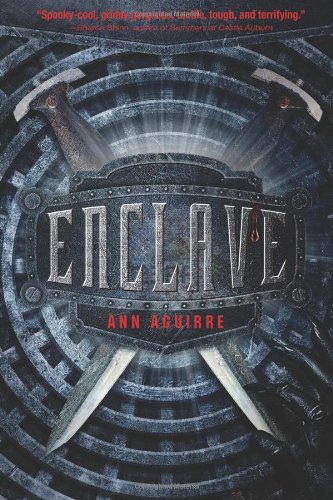
Review: "Enclave" by Ann Aguirre


"Enclave"

Author: Ann Aguirre

Publisher: Feiwel and Friends

Pages: 259

Summary (taken from GoodReads): In Deuce’s world, people earn the right to a name only if they survive their first fifteen years. By that point, each unnamed ‘brat’ has trained into one of three groups–Breeders, Builders, or Hunters, identifiable by the number of scars they bear on their arms. Deuce has wanted to be a Huntress for as long as she can remember.

As a Huntress, her purpose is clear—to brave the dangerous tunnels outside the enclave and bring back meat to feed the group while evading ferocious monsters known as Freaks. She’s worked toward this goal her whole life, and nothing’s going to stop her, not even a beautiful, brooding Hunter named Fade. When the mysterious boy becomes her partner, Deuce’s troubles are just beginning.

Down below, deviation from the rules is punished swiftly and harshly, and Fade doesn’t like following orders. At first Deuce thinks he’s crazy, but as death stalks their sanctuary, and it becomes clear the elders don’t always know best, Deuce wonders if Fade might be telling the truth. Her partner confuses her; she’s never known a boy like him before, as prone to touching her gently as using his knives with feral grace.

As Deuce’s perception shifts, so does the balance in the constant battle for survival. The mindless Freaks, once considered a threat only due to their sheer numbers, show signs of cunning and strategy… but the elders refuse to heed any warnings. Despite imminent disaster, the enclave puts their faith in strictures and sacrifice instead. No matter how she tries, Deuce cannot stem the dark tide that carries her far from the only world she’s ever known.

Cover impressions: After receiving a copy of this book from GoodReads friend Lucy, I was immediately drawn to the Publisher’s Weekly quote declaring the book to be “for fans of The Hunger Games”. Such comparison quotes, while attention grabbing and common practice amongst publishers, immediately set up a certain level of expectations, even in the most cynical of readers. While I haven’t actually finished reading The Hunger Games yet (I’ll get round to it eventually, I swear!), I began this book with the same expectations I have for every dystopian novel – strong world-building and a real threat & sense of danger.

There are books that make me consider discarding use of the flawed star rating system for reviews. Sometimes it’s close to impossible to summarise the qualities of a book into a simple rating out of 5, 10 or however one chooses to do so. A book can be a relatively enjoyable and competently written piece of work that would otherwise deserve a solid rating, but a certain element, event, etc, can bring its rating tumbling down. This happened to me with Sarah Beth Durst’s “Ice” and it happened with “Enclave”. But before I get to why I cannot give this book anything higher than one star, I shall discuss other elements of the book that succeed and fail.

I’m sure you’re all sick of me going on and on about this but the foundations of a strong dystopian novel lie in its world-building. Unusual or disturbing events can’t just happen for shock value. They need to be rooted in the origins of the society, grounded in reason, meaning the reason of this world. This fundamental lack of reason within the world-building in “Enclave” left more than a few questions unanswered. The underground society Deuce lives in does not name its young, known as brats, until a specific age, which is never mentioned. Why? There doesn’t seem to be any specific reasoning behind this rule and seems too impractical to fit in with a world that works to prove itself as fundamentally practical. There are hints of a cult-like mentality to the ruling class of the world but it’s barely touched upon and leaves us with half-built reasoning. Children are sanctioned into one of three groups – warriors, builders or breeders – yet the reasons for specific grouping once again seem at odds with the necessary practicality & needs of this society. One breeder, Deuce’s friend, is seen as ideal for his calling because he is handsome, but I failed to see why this would be a relevant quality in a world where death & disease are rampant. Other extremely questions go unanswered – how does this enclave have clean water after generations underground? How does Deuce go from a lifetime underground to full on exposure to sunlight and only get slightly burned with no damage to her eyesight?

The writing itself is adequate, if simple, and has well-paced action scenes, although the overall pacing is erratic. Certain scenes are evident padding and clumsy plotting, which coupled with several under-developed plot points proves to be somewhat frustrating. No character other than the heroine is given adequate time to develop beyond basic tropes, although I did warm to Deuce somewhat throughout the first half of the novel. However, it is one particular character and how others react to him that soured things for me.

A little more than midway through the novel, Deuce is kidnapped by a gang who make their intentions towards her clear – they intend to use her for breeding purposes, forcefully if need be. Later we are introduced to Tegan, a fellow kidnapped woman who has been raped repeatedly and given birth to stillborn children. After altercations with the story’s main monsters, the Freaks, the head of the gang, Stalker (yes, really), decides he will go along with Deuce, Tegan and main love interest Fade in order to have a better chance of surviving. Fade and Deuce agree to this, despite Tegan’s protests that she does not feel safe around the leader of the gang of rapists who repeatedly violated her for years. Later on, Stalker pushes Deuce against a tree and kisses her.

Deuce reciprocates.

I’ve made my thoughts clear on the ‘bad boy’ trope in YA; I don’t like it. I understand the fantasy behind being the one girl who changes the rebel but ultimately I think it’s a problematic trope that is all too often used as an excuse to have the love interest treat the heroine like dirt, often being rough with her and belittling her.

Patch from “Hush Hush” held his love interest against a bed and talked about how much he wanted to kill her after stalking her, harassing her and generally making her feel uncomfortable and unsafe.

Stalker is the leader of a gang of rapists. It is hinted at in the book that he has raped women before. It is also implied that he may have raped Deuce during her kidnapped period.

He is presented as a potential love interest to Deuce.

The aim of a good dystopian novel is to create a sense of dread. I have seen rape mentioned in other dystopian novels and within the constraints of this world where humans die young and need to reproduce quickly, it makes sense that a patriarchy dominated society would view women in such a manner. However, I have never seen rape used so casually and tossed aside so simply by a character and an author in a YA novel. There is a cruel lack of empathy for Tegan in “Enclave”. Even within the constraints of the novel’s world, one ruled by social Darwinism, to force Tegan to interact daily with the man who stood by & let her be raped repeatedly, possibly ordering the rapes himself or even engaging in the horrific act himself, is baffling at best and disgusting at worst. As the novel progresses, Tegan grows (lazily from a characterisation point-of-view) from a victim into a ‘strong’ young woman who can fight back, but all I could think about was how her rape was used in such a cavalier fashion. Deuce, who started off with such potential (even if she did fall into the typical romantic plot tropes with mysterious bad boy Fade), does not question Stalker or his past actions. Instead, she lays some of the blame on Tegan. The dismissive attitude she has towards a victim of multiple rapes is abhorrent. At one point she asks herself how Tegan could have been so weak as to allow the events to happen. Deuce’s general attitude is that life is tough, and if she can suck it up and get on with her life, so can Tegan. Even within the context of the novel, this felt wrong on every level. Deuce, who had previously shown moments of true empathy, becomes someone who sympathises more with a rapist than the victim of rape. I shouldn’t even have to explain why this made me sick. And that’s why I can’t give this book anything more than one star.

I don’t expect every book in the world to be a beacon of social justice and feminism; that would be stupid. What I do expect is for a book to follow the rules it sets for itself. “Enclave” fails on this thanks to its inconsistent and confusing choices in its world-building, which seem to exist more for shock value than any real sense of reason. It’s a mediocre novel that becomes disgusting when something as serious, life changing and horrific as rape is used so clumsily. Rape is NEVER the woman’s fault. She’s never ‘asking for it’ and she’s certainly never deserving of pity or scorn because she was unable to fight back. Bad boys are problematic enough, but making a rapist not only a sympathetic character, one who receives a degree of sympathy from the heroine not rewarded to the victim, but a potential love interest is flat-out inexcusable.

1/5.

  • Digg
  • Del.icio.us
  • StumbleUpon
  • Reddit
  • RSS

Review: "Ice" by Sarah Beth Durst.

“Ice”

Author: Sarah Beth Durst.

Publisher: Margaret K. McElderry.

Pages: 308.

Synopsis (taken from GoodReads): When Cassie was a little girl, her grandmother told her a fairy tale about her mother, who made a deal with the Polar Bear King and was swept away to the ends of the earth. Now that Cassie is older, she knows the story was a nice way of saying her mother had died. Cassie lives with her father at an Arctic research station, is determined to become a scientist, and has no time for make-believe.

Then, on her eighteenth birthday, Cassie comes face-to-face with a polar bear who speaks to her. He tells her that her mother is alive, imprisoned at the ends of the earth. And he can bring her back — if Cassie will agree to be his bride.

That is the beginning of Cassie's own real-life fairy tale, one that sends her on an unbelievable journey across the brutal Arctic, through the Canadian boreal forest, and on the back of the North Wind to the land east of the sun and west of the moon. Before it is over, the world she knows will be swept away, and everything she holds dear will be taken from her — until she discovers the true meaning of love and family in the magical realm of Ice.

Cover impressions: I’ve changed a lot as a reviewer since I started blogging about YA almost a year ago. I’ve matured my writing style, I’ve learned more about the publishing business, I’ve started to ask more questions and I’ve even made a few friends. I don’t regret my snarky sparkly beginnings because I had a lot of fun and sometimes you have to make a few mistakes to learn from. Nowadays I think I’m a much stronger reviewer and pick my reading choices based upon a more varied selection of reasons beyond snark material. This is why I am glad I didn’t know about “Ice” until I saw it recently. Had I read this last year, I would have blown a gasket and written a review to rival the abusive angels. Now, all I can hope to do is articulately explain why this book made my skin crawl. For this reason, there will be major spoilers.

My interest in “Ice” was peaked when I saw that it was a retelling of “East of the Sun and West of the Moon”, a lesser known fairytale, and was intrigued to see how a YA retelling of a potentially highly problematic tale would work in a contemporary context. Unfortunately, “Ice” seems to be stuck in the Stone Age on so many issues, something that’s made all the more bitter by the fact that the book gets off to such a strong start. Cassie, at first, is a strong minded, hard working and intelligent young woman with high ambitions and an inquisitive nature. Unfortunately, it doesn’t take long for her to slide into a state of uncharacteristic stupidity, occasionally relieved with moments of clarity. However, it wouldn’t be fair to blame Cassie’s decisions for all the book’s wrongdoings, especially since she’s so often left without any real options. She’s practically forced into marrying the Polar Bear King in exchange for her mother’s safe return. Later on, she’s treated even worse, even by the man/bear who supposedly loves her.

There are elements of “Beauty and the Beast” in this tale and it does feel as is “Ice” is trying to replicate the Disney film’s romantic feel (many of the things Cassie says about Bear feel inspired by Belle), but Durst completely skips over any romantic development. There’s a jump in time and all of a sudden, a few weeks later, they’re apparently in love. It further weakens a story that desperately needs a strong author’s hand to make it convincing. Bear may be many generations old with equally archaic ideals but this didn’t adequately justify his actions towards Cassie.

There are certain things a romantic hero should never do. Tampering with a woman’s birth control is one of them. Cassie, who has been on the pill, finds herself pregnant because Bear used his magical powers to fix the chemical imbalance in her that was preventing a pregnancy. He didn’t discuss this with her, there is no instance of a conversation taking place between the two that discusses such matters, and he doesn’t even tell her she’s pregnant until she’s 3 months gone. I do not care how gracious or kind Bear was to Cassie earlier on (her words, not mine), you DO NOT DO THAT! True relationships are built on trust and mutual understanding. He never even talks to her about this. What makes it even more blood curdling is that Cassie forgives him. She kicks up a completely justifiable fuss beforehand, but in the end, she’s completely willing to give up all her future ambitions of university, a career and a life with her family, including her mother who she hasn’t seen for most of her life, to be a teenage wife and mother with a talking polar bear.

Sadly, this isn’t the worst part. After Cassie has to go on a quest to retrieve Bear, who has to swear himself to the Troll Princess due to a rather convoluted loophole that I won’t explain here because it’s inconsequential, everyone she meets is obsessed with the safety of her unborn child. Not her, just her unborn child. Every other spirit, creature and guardian that she meets, of varying species and ages, cares not for her but for the fetus she just happens to be in charge of for the next few months. One character, who is thankfully painted as something of a villain, keeps her captive and indirectly harms her in an effort to stop her saving Bear because the life inside her is more important than her own. Cassie is also given the nickname “Little mother” by these creatures. Her entire worth is based on the fact that she has a functioning uterus and that’s a hell of a lot more important than her own mind and decisions. Cassie doesn’t like this attitude, it angers her, and rightly so. But why doesn’t she display this anger towards Bear, who admitted that he wanted a wife to bear his children, a task he decrees to be the most important purpose of the marriage? Cassie isn’t stupid, yet she is completely willing to let the designated love interest make these decisions for her, even if they involve lying, and in the end it’s okay? Bear says he loves Cassie but for me, all I could see was a liar who was willing to sabotage a young woman’s life in order to get what he wanted. Cassie was left to be nothing but a breeding specimen with one use.

To be truthful, this is a well written book that is generally well paced and has an interesting mythology throughout the story. The action scenes are well done and when Cassie was an active heroine, I really appreciated. But I would be lying if I gave this book anything more than 1 star. I can’t get behind a romance built upon a much older man using an 18 year old girl in that way. Tampering with birth control and essentially trapping the wife you forced into marriage doesn’t not make you the romantic ideal, it makes you sick. Just because the original source material is old, that doesn’t mean one is obligated to keep the retelling stuck in the 1950s. Cassie was much more than a “little mother”, so to see her happily accept the fate she was forced into as the ideal life made me so sad. She was worth more than that. We all are.

1/5.

  • Digg
  • Del.icio.us
  • StumbleUpon
  • Reddit
  • RSS

Dear Constable & Robinson/Running Press publishers...

You just lost a customer.


I woke up this morning with a tweet from my friend Catherine Haines directing me to Jessica Verday's blog. Verday, the writer of the Hollow series (which I have not read but am tempted to go out and buy the entire series after this), announced that she would no longer be part of the Wicked Pretty Things anthology, edited by Trisha Telep and published by the above publishers in UK and USA, after she was asked to make some changes to her story:

I've received a lot of questions and comments about why I'm no longer a part of the WICKED PRETTY THINGS anthology (US: Running Press, UK: Constable & Robinson) and I've debated the best way to explain why I pulled out of this anthology. The simple reason? I was told that the story I'd wrote, which features Wesley (a boy) and Cameron (a boy), who were both in love with each other, would have to be published as a male/female story because a male/male story would not be acceptable to the publishers.


I'll try to keep the "not-so-simple" reason from becoming a rant and just sum it up by saying that that was SO Not Okay with me. I immediately withdrew my story and my support for the anthology.

I think we can all agree that's bloody disgusting. Welcome to 2011 everybody; not only do people only want to read stories about straight couples, gay love stories shouldn't even bloody exist! I applaud Verday for sticking to her guns and removing her story from the anthology. Frankly, I am disgusted that such open bigotry was considered acceptable by a publishing house in relation to a YA anthology. Yes, the default mode in fiction seems to be that of the pretty white straight couple but that's not the default mode for life and it damn well shouldn't be the default mode for love. What does this move say about LGBT teens? That they don't deserve love? Everyone deserves love. Who you fall in love with should be inconsequential. Jessica Verday wanted to send a message to her fans that it doesn't matter who you fall in love with but the publishers decided that wasn't good enough for them. I am pretty angry about this. You'd think we'd have moved on from all this, especially in 2011, but obviously not. So goodbye Constable & Robinson/Running Press, you just lost a customer.

I wholeheartedly encourage you all to read as many books as you can, especially those with LGBT characters. Even if some people don't want you to know it, but LGBT teens do exist and their love stories are just as worthwhile as that of the supposed default mode.

EDIT: Trisha Telep, the editor of the anthology commented on Verday's post taking responsibility for the decision:

Oh dear. Might as well give you my two cents. Not that it really matters but... Don't take it out on the publishers, the decision was mine totally. These teen anthologies I do are light on the sex and light on the language. I assumed they'd be light on alternative sexuality, as well. Turns out I was wrong! Just after I had the kerfuffle with jessica, I was told that the publishers would have loved the story to appear in the book! Oh dear. My rashness will be the death of me. It's a great story. Hope jessica publishes it online.

I'm glad that responsibility has been taken for this decision, which was wrong on Telep's part. I question her word choice for one thing (alternative sexuality? Is it automatically more explicit because it features a gay couple? I don't quite understand. Would it be considered 'alternative race' to have depictions of people of colour in teen relationships in this anthology? I'm not buying it.) and the rashness of her decision really says something about this day and age in media for me, especially since YA has proven itself to be one of the more progressive media fields of late in LGBT depictions. I hope Jessica Verday does publish the story online or finds another publisher/anthology for it.

  • Digg
  • Del.icio.us
  • StumbleUpon
  • Reddit
  • RSS