Once again, thank you for the comments and your thoughts. I have
a few more things I’d like to discuss regarding some points I made in my “Matched”
review regarding the separation of author and text, but I think it may be easier to do so in a
separate post, possibly on The Book Lantern. I know I said “The Selection”
would be my next entry, but cheap Kindle deals plus my birthday plus an
uncharacteristically lovely day meant I just had to move onto another book with
a lot of hype and a dead end.
Summary (taken from Goodreads): The year is 2032, sixteen years after a deadly virus—and the
vaccine intended to protect against it—wiped out most of the earth’s
population. The night before eighteen-year-old Eve’s graduation from her
all-girls school she discovers what really happens to new graduates, and the
horrifying fate that awaits her.
Fleeing the only home she’s ever known, Eve sets off on a long, treacherous journey, searching for a place she can survive. Along the way she encounters Caleb, a rough, rebellious boy living in the wild. Separated from men her whole life, Eve has been taught to fear them, but Caleb slowly wins her trust...and her heart. He promises to protect her, but when soldiers begin hunting them, Eve must choose between true love and her life.
Fleeing the only home she’s ever known, Eve sets off on a long, treacherous journey, searching for a place she can survive. Along the way she encounters Caleb, a rough, rebellious boy living in the wild. Separated from men her whole life, Eve has been taught to fear them, but Caleb slowly wins her trust...and her heart. He promises to protect her, but when soldiers begin hunting them, Eve must choose between true love and her life.
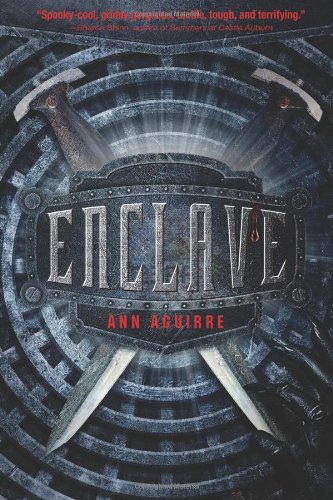
Cover impressions: The moment “Twilight”
is invoked in the promotion of your book, you’ve got some serious hype to live
up to. The same applies to the use of “The Hunger Games”. However, to bill a
book as a combination of both is just setting yourself up for disappointment. It’s
not unusual to see such comparisons made in the advertising of a book. It’s the
entire backbone of the Orwell Project, after all. Publishing, now more so than
ever, needs to make money, and the easiest way to get the tills ringing is to
create hype. It’s not always successful, as we’ve discussed, but when deployed
in the correct manner it can work wonders. “Divergent” managed it but “Matched”
and “Eve” both stumbled. With “Eve”, I can easily see why, just from that
promise of “The Hunger Games meets Twilight”. For many, the romance was a
crucial part of “The Hunger Games”.
I’ve only read the first book, a
shameful admittance on my part, but I always felt that the romantic element
felt tacked on. Suzanne Collins’s agent admitted that she had suggested more
romance for the series, whilst Collins was more interested in the war element. It
shows, even in the first novel where the manipulation of narratives such as a
dream romance broadcasted live make up a fascinating part of the story. I know
many people disagree with me on this, but romance has never felt like a
crucial, necessary or even particularly interesting addition to a dystopian
narrative. It feels distracting, often serves solely to fill pages and suggests
a complete lack of priorities for the protagonist. When society has crumbled
and you’re up against a totalitarian government or something similar, you
should be more worried about that than if the guy you like will hold hands with
you. Romance works best as a secondary plot, and even then it’s tough to pull
off well, so to push it front and centre is asking for trouble. So, with that
long ramble off-topic, I bring the project back to “Eve” with the shocking
revelation that I genuinely enjoyed it for the first third of the novel.
“Eve” opens with the introduction
of an all-girls’ school, walled off from the rest of society in the remnants of
what once was America, ruled by one King. These girls, having lived comfortable
lives and educated in trades they believe they will spend their lives working
in, are set to graduate and move into the next level of education. For school
valedictorian Eve, her dream of being an artist is in sight, but her world is
shattered when she sees the truth for herself – eighteen year old girls are
strapped to beds, forcibly impregnated and must breed continually in order to replenish
the country’s population. Understandably, Eve runs away, directed by one kind
teacher to follow the path to a safe haven known as Califia. On the way,
accompanied by fellow runaway Arden, she meets a man for the very first time,
Caleb, who helps the pair out and shelters her from the military, who are keen
to bring her to the main city where she shall take her place as the King’s new
wife.
Up until Eve meets Caleb, the novel
is rather enjoyable. It’s by no means a masterpiece and the first person
narrative became a tired staple of the genre long ago, but the first third of “Eve”
remains well paced with a genuine tension and hints of an exploration of the
change in gender roles when society crumbles. Given dystopian fiction’s history
in tackling women’s issues, most notably in Margaret Atwood’s classic novel “The
Handmaid’s Tale” and, more recently, in the much hyped YA debut of Lauren
DeStefano, “Wither” (see my review here), it’s no surprise to see another novel
tackle the topic. However, it quickly becomes apparent that the author has no
real interest in such issues, nor indeed in accurately developing a world where
such drastic changes in gender roles would occur. It’s another world with a single
non-democratic ruler that briefly mentions a decadent city where the rich live
carefree, much like the Capitol, but the decision to divide the sexes and have
the girls be explicitly taught to fear and hate men before forcing them to
breed leaves the reader with nothing but questions. Surely if such a
patriarchal system were to be instigated then it would be far easier and more
sensible to teach the girls about traditional domestic roles of housewife and
mother. To push this traditional role not only as the norm but as the girls’
sole function would require the involvement of men, even if sexual intercourse
never takes place. Spending seemingly unlimited resources on providing schools
of young girls with comfortable room, board and several years of education also
seems pointless. One character says this is done because it makes the next step
easier if they have had several years of the supposedly fulfilled purpose of
learning a trade. While Eve’s naivety and fear is perfectly in character, to
have her go through such a u-turn, from fearing men her whole life as she has
been taught, to becoming entirely consumed by the first one she meets, feels
unnatural and rather insulting. It asserts the insinuated gender norm of the
society, that women are passive and need to be protected. While I wouldn’t
quite compare it to “Twilight” as the marketing did, the author’s need to
insert a romantic angle ruins the promising potential of “Eve”.
Let’s talk about reproductive
issues in dystopian fiction. Science fiction has a long standing history of
using the body and its subsequent invasion as a metaphor. The numerous “Invasion
of the Body Snatcher” movies used its eponymous theme to tackle contemporary
fears and issues such as the McCarthy witch hunts. Ridley Scott’s “Alien”, its
sequels and the recently released sort-of prequel “Prometheus” famously tackle
the fear of bodily infection and loss of control over ones extremities. Personally,
nothing terrifies me more than losing power over my own body. Today, with women’s
rights being constantly threatened and abortion providers being shut down,
severely limited in their power and even birth control coming under entirely
unfounded scrutiny, it’s not a surprise to see teen fiction tackle the topic. That’s
not even taking into account that glorious thing known as puberty, a horror
scenario to many a teenage girl.
At the heart of these books, mainly
“Eve” and “Wither”, although we can’t have this discussion without mentioning “The
Handmaid’s Tale” (a similar theme appears in the next Orwell Project entry “Glow”),
is the terrifying and not all that fantastical idea that society views a young
woman’s worth solely as a walking womb, and that she shouldn’t even have
control over that. Given the dystopian genre’s long and illustrious history in
exploring the contemporary world through seemingly fantastical scenarios, this
is a theme that deserves proper execution. My main issue with “Eve” and “Wither”
is that they shy away from the nitty-gritty of the matter and because of this
they end up falling into some tired and suspect tropes of general YA. Despite everything
that occurs in both novels, both heroines end the novel with their virginity
intact. This is especially uncomfortable in “Wither” given that heroine Rhine’s
13 year old sister wife ends up pregnant while the husband respectfully keeps
his distance from the 16 year old. The novel sets up a genuinely unnerving premise
– a world where women are forced into polygamous marriages in order to quickly
repopulate the earth before a virus kills them all at the age of 20 – and refuses
to go all the way. “Wither”, like “Eve”, has many problems in its
world-building, but by setting up the ridiculous and damaging dichotomy that the
heroine’s ‘goodness’ is inextricably connected to her ‘purity’, the novels end
up going against that they’re supposed to be condemning. I’m not saying that
the heroines had to have sex or be raped or be subjected to something equally
gruesome and degrading; that’s horrific. The issue here is in the authors
mollycoddling their heroines against the world they have created. What is the
point of setting up such a scenario if the reader is perfectly aware that the
heroine is safe from the evils they’re up against? Ultimately, “Eve” fails to
live up to its potential because it refuses to fully embrace the premise it has
created.
I’m not exactly known for my
ringing endorsements of romance in young adult novels. It’s not that I hate
romance – I love it and happen to think that it’s one of the most challenging
and rewarding genres in fiction, both to read and to write. My issue has always
been with the oversaturation of romance in the genre and the reliance of
insta-love over true characterisation. Not only does “Eve” squander its
potential as a dystopian novel in favour of focusing on the romantic angle, the
romance itself is dull, uninspiring and fails to work on its own level. It just
doesn’t work in the world Carey has created. The novel is far more concerned
with high school rom-com style misunderstandings and stolen glances, something
which this reader found mind-boggling considering the evidently more important issues
unfolding throughout the novel. The series has potential as a whole but in
order to fully live up to it, the author needs to fully embrace the concept she
has created, spend far less time worrying about the romance, and to tighten up
the world-building and mood substantially. However, the abrupt ending and clear
assertion of the heroine’s priorities (take three guesses) don’t fill me with
much hope.