Followers

Powered by Blogger.
RSS
One highly opinionated feminist YA nerd's twisted, snarky and informative journey through the genre's perils, pitfalls and sparkles.

Review - "The Eternal Ones" by Kirsten Miller

“The Eternal Ones”

Author: Kirsten Miller.

Publisher: Penguin Razorbill.

Pages: 416.

Synopsis (taken from GoodReads): Haven Moore can't control her visions of a past with a boy called Ethan, and a life in New York that ended in fiery tragedy. In our present, she designs beautiful dresses for her classmates with her best friend Beau. Dressmaking keeps her sane, since she lives with her widowed and heartbroken mother in her tyrannical grandmother's house in Snope City, a tiny town in Tennessee. Then an impossible group of coincidences conspire to force her to flee to New York, to discover who she is, and who she was.

In New York, Haven meets Iain Morrow and is swept into an epic love affair that feels both deeply fated and terribly dangerous. Iain is suspected of murdering a rock star and Haven wonders, could he have murdered her in a past life? She visits the Ouroboros Society and discovers a murky world of reincarnation that stretches across millennia. Haven must discover the secrets hidden in her past lives, and loves¸ before all is lost and the cycle begins again.

Cover impressions: I am very picky about my romances, especially when it comes to the notorious minefield that YA romances has become. With the paranormal YA genre populated with instant love, jerkiness masquerading as love, tragic live with no consequences, obsessive love and stalking as love, it’s all become a little depressing. With “The Eternal Ones” we have an emphasis on reincarnation with romance, something that was touched upon with disastrous incompetence by Lauren Kate in “Fallen.” When I was working in a bookshop last Christmas, the employees were allowed to take home some of the ARCs that were sent into the store and I was lucky enough to get an ARC of this book but it’s taken me a long time to actually finish reading the book.

Reincarnation as a central theme in a story is an idea with fantastic potential but said potential can also be mishandled very easily. It’s all too easy to use it as a get-out-of-characterisation-and-development-free card and I’m afraid that’s what “The Eternal Ones” does for the larger part of the story, which is a shame because the initial set-up was intriguing: a young woman in a claustrophobic small town with traditional beliefs and old fashioned scare mongering coupled with her confusion over her visions and what they all mean could have been something genuinely gripping in the tradition of the Southern gothic, a genre I am a complete sucker for. Haven, cheesy name choice aside, starts out an interesting enough heroine, and the small town residents well rounded enough to keep the story going, although there are moments where they’re seriously at risk of falling into caricature territory, but the moment Iain enters the equation, it goes downhill very quickly.

There’s no development between Haven and Iain as lovers. They meet face-to-face about a hundred pages in and that’s that. While Miller tries to throw a few red herrings and speed bumps in the way of their relationship, they offer no real depth to the characters and actually served to make me dislike the couple more and more as the story progressed. Haven showed brief moments of strength and backbone but all too often she fell into stupid mode and blindly accepted Iain’s explanations even when she knew they were lies. I’m not sure how everyone else feels but I can’t be the only one who is sick of the so called hero constantly lying and keeping important secrets from his supposed love to ‘protect her’ and ‘keep her safe’, when just keeping her up-to-date on what’s happening would surely be of more use to her. Iain doesn’t come across as a gallant hero or love for the ages; he just comes across as an entitled jerk. The reincarnation element seemed like such a cheap move to pull in lieu of real development between Haven and Iain – they already know each other and loved each other in a previous life as different people so why get to know each other in this life? Because people obviously never change. Haven’s jealousy over Iain’s playboy reputation is apparently one of the reasons he loves her over their many lifetimes together, which I found to be an odd thing to like about someone. Surely such emotions aren’t a strong foundation for a relationship? There was no real fire or heat between the pair, let alone trust or mutual respect.

The plot, with its numerous red herrings and pointless dead ends that added nothing to the story, was serviceable but far too long. At over 400 pages, a stringent editor could have done wonders with the story and streamlined it more for a quicker paced read. The lack of serious development over these pages was also disappointing, especially since the potential was limitless. I found myself imagining new ways to write the story; Haven being unsure whether her visions are real, the result of madness or possession, the conflict between religion and medicine in a small, suspicious town, the conflict between religions (a brief scene involving Haven visiting a different church with a friend revealed some interesting possibilities) and the difficulties between Haven, her family and the town’s residents, etc. Some ambiguity could have done this story wonders, but everything was so clean cut and even when doubt was thrown into the equation, one never fully believes that there’s any true alternative to the designated storyline.

Haven’s visions also suffered from the typical path of magical powers in YA in that they only showed up when it was convenient to the plot and only just revealed enough to keep Haven in the dark at all times. It became rather annoying after a while. Outside of the breeding pair, the supporting cast ranged from interesting (Haven’s friend Beau was sweet and their friendship didn’t feel too forced) to clichéd (the town preacher who had potential to be much scarier than he was) and cardboard cut outs (Haven’s fiercely religious grandmother was a shrill, two-dimensional figure with potential – I keep using that word – to be so much more). The ending does pick up the pace, with the villain of the piece finally turning up a little late to the table, and throws in a few interesting elements that I wish had been added earlier to the story, although seeing as this is the first in a series, it will be interesting to see how Miller develops his potential.

Overall, I didn’t hate this book, I just felt disappointed. It had such great potential and the prose was strong enough to support it but the plotting fell back on easy conveniences and a poorly developed romance between stock characters with no unique qualities. There is further potential for the sequel to be interesting if Miller sticks with the intriguing parts but the reliance on easy ways out left me feeling cold. Reincarnation is a fascinating idea and deserves an equally fascinating story to back it up. This just isn’t it.

2/5.

On a more shameless note, my next post on The Book Lantern, where I'll be recommending underappreciated Scottish teen fiction, should be up today so go check it out and leave a few comments on our posts!

  • Digg
  • Del.icio.us
  • StumbleUpon
  • Reddit
  • RSS

Come light a (book) lantern!

Do you like YA? Do you like discussion? Do you like this blog but can't stomach the idea of reading post after post written by me and plead for other bloggers to take over?

Then come on over to The Book Lantern!

A group of my friends on GoodReads got together over a steaming pile of interwebs trouble and decided to start our own blog. It's similar to the Sparkle Project but with more of us to share the blame! We've got bloggers from all over the globe with many opinions on YA to share. Each day of the week will bring a new blogger with reviews, discussions, debates, questions, fangirling and antici...

...

...pation!

I'll be making my first solo post there on Thursday, but our very first post is a group discussion on what makes a good (or bad) paranormal YA. I'll still be doing the Project of course (and thank you for all your kind - and not so kind - words lately) but the reviews I post on the Book Lantern will not be posted here. So please check it out and leave us some comments with suggestions for reviews, news, discussions and anything else you want to hear about.

(This post has been the perfect example of why I should never go into comedy! Thank you!)

  • Digg
  • Del.icio.us
  • StumbleUpon
  • Reddit
  • RSS

#YAMafia - my response.

I wasn’t going to respond to the #YAMafia thing (although I do wish I’d come up with a much more creative phrase) because everyone else already had an opinion on it and there were a lot of great blog posts on it already without me throwing my towel into the ring (check out Justine Larbalestier’s post, where my GoodReads friend Phoebe North was quoted). After the Bitch Media discussion that quickly turned into a fiasco, I wanted to avoid trouble. So I said I’d keep out unless I was mentioned directly. I was and, well... it was interesting.

So I’m responding.

First of all, R.J. Anderson is right. I didn’t refute the person on my blog who said “find the bitch... and kill her dead.” I honestly missed that comment. I got a little swamped under by the sheer volume of comments the original project was getting and it completely passed by me, but that’s no excuse. I should have refuted that comment and I didn’t, and I can only apologise sincerely for not doing so. I didn’t do my job properly.

I know it’s become increasingly difficult to believe for some but when I started doing the Sparkle Project in July 2010, it wasn’t part of some bully blogger snark fest or a mindless rambling session. I genuinely wanted to write something that talked about issues I worry about in a genre I love. Despite everything, I do love reading and YA. I’m an obsessive reader, I study literature at university and I love to write. Doing the reviews gave me a chance to discuss stuff I found problematic, like slut-shaming, anti-feminist attitudes directed at a teenage audience, rape culture, etc, as well as the familiar tropes of the paranormal genre, and how overused they’d become (I’ve been studying genre lately for class and it’s pretty fascinating to see how well defined a genre can become in such a short amount of time.) Yes, I did it snarkily because I wanted it to be entertaining. I understand that snark and sarcasm is subjective but I never intended to cause personal offence to any of the authors whose work I reviewed. It takes a lot of effort for me to be funny and if I failed in that aspect, and did inadvertently end up insulting people, I apologise repeatedly for that as well.

On the topic of interaction, and the hashtag that started it all, I wish I’d explained myself better. My original concerns about this topic of clique behaviour came from my “Shiver” review where Maggie Stiefvater replied directly to me. This was a hugely uncomfortable thing for me (I think reviews are primarily for readers and consumers, I really don’t feel comfortable with authors responding to any type of reviews, it’s easier and less intimidating for readers to have that safe place for discussion, etc.) and I tried to explain myself to the best of my abilities. It did feel like Stiefvater was telling me to stop doing reviews or I’d never become a published YA writer in the future, and that I should also watch out with my following review of Carrie Ryan’s “The Forest of Hands and Teeth” because Ryan was a friend of hers. I did write the most positive review of the Project for Ryan’s book because I genuinely enjoyed it, although I still had problems with it. You can check the post out here and see how it reads to you but for me at the time, and still today, it felt like a veiled threat and that made me hugely uncomfortable.

The Mafia thing wasn’t just about that; it was about watching authors tell reviewers and future authors to “be nice” or else they’d risk bad karma and people like Becca Fitzpatrick would take any opportunity to mock you about it and having her author friends congratulate her for supposedly taking the high road (the original entry has since been Flocked on LJ but is available to read on GoodReads.) It was about watching author friends give each other cover quotes when to me it felt like “doing your friends a favour” instead of judging the work based on its merits (hell, I can’t even review the book of an author who I’m friends with on LJ and twitter, it just feels too close for me.) It was about seeing authors brag about their good connections and how they helped them get publishing deals, as was the case with Aprilynne Pike and her friend Stephenie Meyer, who passed her book onto her agent Jodi Reamer. It was about hearing from other bloggers who has also been on the receiving end of bad author behaviour (said people do not want to be named so I hope you respect that, even if you don’t believe me). It was about watching bloggers be accused of something akin to censorship for discussing what they saw as extremely problematic, then twisting their words around to fit their argument better (The Book Smugglers’ review of “Sisters Red” being the prime example here, especially in the wake of the Bitch media mess). It was about watching author after author fawn over a mediocre writer with a documented history of fandom plagiarism solely because she sold well.

It was about never seeing authors or people in the YA industry discuss some of the anti-feminist attitudes prevailing in an increasingly popular trend, where a character is simply a sexy bad boy for holding a girl down on a bed against her will and saying he wants to kill her. I understand being professional, I really do, but I didn’t think then, and I still don’t, that professionalism included putting your fingers in your ears and ignoring the obvious. It’s become somewhat acceptable for writers and such to mock the “Twilight” books and talk about the anti-feminist attitudes (among the plethora of wrong those books contain) but that only happened when the books got worldwide attention because of the movie. The book had moved beyond the boundaries of teen literature and morphed into a genuine phenomenon, for better or worse. Someone once asked me why I wasted my time talking about these issues in YA but never other media, because all media is on some level responsible for these prevailing anti-female attitudes. That’s completely true, and I condemn all those attitudes in media, be it movies, books, music, politics, TV, etc. I chose YA specifically because it was seldom talked about and because it reaches an increasingly large audience of young, impressionable people. I read a lot of YA and it was something I was familiar with (I don’t own a TV so couldn’t talk too much about that, I’m terrible at analysing music and my film criticism skills need major improvement from my days of teen blogging Disney movies). I didn’t think something should get a free pass for problematic content just because it wasn’t well known, or because it was considered lesser on some level (I’ll continue to defend YA to the pain against anyone who says YA is a lesser form of literature because that’s complete BS.)

When the author stops writing the book, had edited and proofread it, gone through all the small details, passed it onto the editor, gone through more changes, gone through the entire publishing process and their work put onto shelves, that book is, to an extent, no longer theirs. At least, their own interpretation of the work is no longer the only one, and the book is open to criticism, interpretation and opinions from everyone who reads it. So authors need to be careful and understand why bloggers and reviewers often get as passionate as they do, especially when issues of feminism, sex and women in relationships come up, because we’ve got every other element of entertainment telling us certain things about how a young woman’s supposed to act and it gets frustrating to read a book telling you how bowing down to the man in your life is okay. Having said that, bloggers also need to be careful. We have the added gift of being able to edit what we say (although I seldom ever do) but we still need to be careful. With great snark comes great responsibility, and the same goes for all reviews. We should back up our snark as much as possible and present a strong argument as to why we dislike or like a book. Bloggers aren’t ‘haters’, they don’t read books because they hate them, I certainly don’t. I love reading, most of my life has been centred around books in some way and they’ve influenced me greatly. They continue to influence me. I always thought if nothing else came out of my blogging then I’d like people to start having the right conversations about this genre, which has been happening (not all my influence obviously, I’m not a particularly important blogger) and for that I’m glad. This thing got big, bigger than I expected it to. I still get wide eyed with shock when I realise just how many people have read my reviews and commented on them. This was never about pissing people off or creating enemies, it was about talking about something I was seeing and reading and wanted to see talked about further. Obviously on some level I have failed in my reviews (I’ve never been called crazy or an embarrassment to book blogging before, that’s a new one.) I’m getting better at blogging – I’m a much better reviewer now than when I started – but I’m also in a more vulnerable position, which I can’t complain about because I love to review and I’ve met so many great people through it, as well as learning a lot about my own stories. I’m not sure how to properly end this thing. Once again, I profusely apologise for not refuting the nasty comments on my blog; in that aspect I definitely failed, which I will strive to fix in my later reviews. Even if I’m the crazy embarrassment, I’m glad we’re at least having these types of conversation and I hope we continue to do so.

I’m cross-posting this to my LJ because the blogger commenting system is apparently dodgy on my blog.

  • Digg
  • Del.icio.us
  • StumbleUpon
  • Reddit
  • RSS

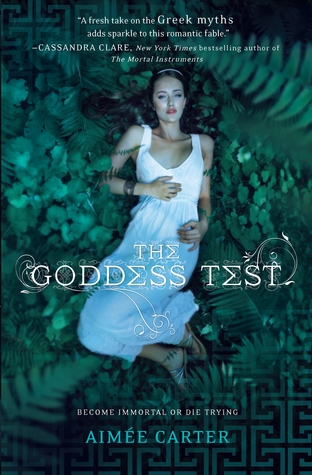
Review - "The Goddess Test" by Aimee Carter.

“The Goddess Test”

Author: Aimee Carter.

Publisher: Harlequin Teen.

Pages: 297.

Synopsis (taken from GoodReads): Every girl who has taken the test has died. Now it's Kate's turn.

It's always been just Kate and her mom--and now her mother is dying.

Her last wish? To move back to her childhood home. So Kate's going to start at a new school with no friends, no other family and the fear her mother won't live past the fall.

Then she meets Henry. Dark. Tortured. And mesmerizing. He claims to be Hades, god of the Underworld--and if she accepts his bargain, he'll keep her mother alive while Kate tries to pass seven tests.

Kate is sure he's crazy--until she sees him bring a girl back from the dead. Now saving her mother seems crazily possible. If she succeeds, she'll become Henry's future bride, and a goddess. If she fails...

Cover Impressions: I love Greek mythology. I love Greek tragedies. I love the gods and goddesses and what they all represent and the timeless stories that accompany them. As with all people who love something, I am weary with re-imaginings and modern day updates of these tales. Some can be brilliant and really update the text to fit with the modern era, others can fail miserably. I was holding out hope for Carter’s debut (with a sequel in the works) since I have always been fascinated by the Hades and Persephone myth. There’s also a number of Greek tragedy related YA books coming out soon (including the much talked about “Starcrossed” in which the author received a 7 figure advance for what is billed as Percy Jackson for girls) so my interest was piqued enough to request an ARC on GoodReads.

There was a phrase I kept using whilst reading the second half of this book – “What a dick move.” I apologise for the lack of eloquence here but it was the only thing I could think about the more this novel went on. To start off it wasn’t bad. It wasn’t brilliant and was definitely following a set pattern of mediocrity but there were a few moments I enjoyed, specifically Kate’s emotions regarding her dying mother. They were handled well and without overtly saccharine bucket-loads of cheap emotional grabs, and it was interesting to see a paranormal YA character dealing with such a difficult problem. Of course, this was quickly shoved aside for the plot, or what substituted for one.

For the first half, “The Goddess Test” wasn’t horrifically bad, it was just mediocre. It seemed to be made from a well worn mould of YA fiction – outcast heroine who immediately garners male attention, jealous female antagonist who quickly becomes friend but fits all the clichés of flighty and annoying, mysterious and tormented supernatural figure to serve as love interest, bad boy moments, technical entrapment, etc. I’d read it all before and it wasn’t anything particularly exciting. Kate and Henry’s relationship was very poorly developed and didn’t make a whole lot of sense, not to mention how decidedly dull Henry was. How can you make Hades dull? By making him a moping misunderstood bad boy, that’s how. The Hades-Persephone myth was twisted into a more teen friendly shape where Henry was made into the victim, which bugged me to no end. Then again, these characters are so un-godly it makes sense to twist the myths to fit them.

The characters are the story’s main failing for the bigger part. Kate is fine for most of it until she falls into love-struck too-annoying-to-live territory, typical for paranormal YA heroine these days it seems, and Henry is just dull. None of the immortal characters ever seem like fully fleshed out beings, let alone gods. They never convinced me that they were anything more than childish plot devices. The Greek gods could be childish but they could also be ruthless, passionate, cunning, devastatingly dangerous, charming, every other emotion you could think of. Here, the characters just served to keep the meandering plot from going too off-road.

And this was all well and good for the most part. Like I said, it was mediocre but not awful. Then we got into the second half and things changed. What made up the supposed plot and the tests that were so important in deciding whether or not a teenage girl was worthy to become an immortal and co-ruler of the Underworld and the dead become more and more contrived to the point where I was rolling my eyes every other page. Not once was I convinced that Kate was goddess material and the so-called tests just made me think that the Olympians need to hire a new manager or something. but the biggest dick move came in the final few chapters, which I am going to spoil because I was so peeved off by them that I need to share my rage.

SPOILERS BELOW.

I MEAN IT. DON’T BLAME ME IF YOU’RE SPOILED AND DIDN’T WANT TO BE.

...

Okay?

It was all a test.

I have this really big problem with books that reveal the hero/heroine is the pawn in a big game of “Fuck You, It Was All Fake.” I hate when it turns out that the character was lied to by absolutely everyone she cared about just so they could have the right results. No matter how badly contrived they are – like Patch manipulating everyone around Nora to get the right results in “Hush Hush” – or how happy the hero/heroine is with the results, I still think it’s a massive dick move to pull. How can one establish a relationship if there is no trust and never was from the beginning? That’s why I sighed “Oh, come on now!” out loud when it was revealed that everything Kate thought she knew – including HER OWN MOTHER DYING! – was constructed solely for her to take the tests to become Persephone number 2. See, Kate’s mother is one of the goddesses testing her so she was never really dying (okay, her human form was dying but she still lives on in some form.) And Kate is okay with everyone lying to her, or as they put it, hiding the truth from her to keep her safe because those are the rules. It was poorly constructed, it was incredibly contrived and it was a pure and simple dick move. It immediately destroyed any sympathies I had had with the book. I just didn’t care anymore.

“The Goddess Test” is a mediocre book, chock full of everything one expects from paranormal YA these days, with serviceable prose and a few moments that keep things going amidst the dull characters and meandering plot. But the big reveal that makes everything okay for everyone except the reader just throws my ability to care out the window and frankly, it pissed me off. Can we stop using characters, especially teenage girls, as pawns in stories? Can we treat them with a little more respect than this? I can’t recommend this book, it just doesn’t seem to care about its readers at all, be they Greek mythology fans or not. This book’s left me with the same feeling I felt the very first time I saw the infinitely superior piece of entertainment, “The Wizard of Oz”, when it’s revealed to all be a dream. That wasn’t fair.

1/5.

“The Goddess Test” will be released in USA on April 19th 2011. I received my ARC from NetGalley.com.

  • Digg
  • Del.icio.us
  • StumbleUpon
  • Reddit
  • RSS